

Yes — for most healthy adult dogs, pasteurized goat milk is a safe, digestible supplement when given in moderation. It offers a gentler alternative to cow’s milk, thanks to smaller fat globules and a slightly lower lactose content that many dogs handle better. That said, it is not a superfood with bulletproof science behind it, and a few dogs should avoid it entirely.
- Why it can help: Easier to digest than cow’s milk for many dogs, with useful nutrients like calcium, potassium, and vitamin A; vets often recommend it as a palatable recovery aid or appetite stimulant.
- When to skip it: Dogs with pancreatitis, obesity, diagnosed food allergies, or severe lactose intolerance should not have goat milk without explicit veterinary approval.
Always check with your vet before adding anything new to your dog’s diet. If you’re in Orléans, Petbite carries the Raw Goat Milk Original 975 mL as a local, convenient option.
Key Takeaways
Pasteurized goat milk is a safe, digestible supplement for most healthy dogs when introduced gradually and kept to a modest serving size, with veterinary guidance for any dog with existing health conditions.
| Point | Details |
|---|---|
| Pasteurized only | Always choose pasteurized goat milk; raw milk carries Salmonella, E. coli, and Listeria risks. |
| Introduce slowly | Start with 1 teaspoon (small dogs) to 2 tablespoons (large dogs) and watch stool for 48–72 hours before increasing. |
| Evidence is limited | Most health claims are anecdotal or clinical-experience based; no large peer-reviewed canine trials confirm them. |
| Know when to skip it | Dogs with pancreatitis, obesity, food allergies, or prescription therapeutic diets should avoid goat milk without vet approval. |
| Local availability | Petbite in Orléans stocks the Raw Goat Milk Original 975 mL with free same-day delivery within 3 km. |
Table of Contents
- What are the real benefits of goat milk for dogs?
- What nutrients does goat milk actually contain?
- Is raw goat milk safe, or should you choose pasteurized?
- How do you introduce goat milk and how much is safe?
- Which dogs should not have goat milk?
- What forms does goat milk come in and how do owners use it?
- Where can you buy goat milk for dogs in Canada?
- A practical perspective on goat milk and responsible use
- Petbite’s Raw Goat Milk is available for local pickup and delivery
- Sources
What are the real benefits of goat milk for dogs?
Owners and veterinarians commonly report several benefits, though the evidence base matters here. Great Pet Care notes there are no large, objective peer-reviewed studies proving goat milk’s many claimed health benefits in dogs. Most positive reports come from clinical experience and owner observation, not controlled trials. That does not make them useless, but it does mean you should calibrate expectations.
Here is what the evidence, thin as it is, actually supports:
- Digestion support: Many dogs tolerate goat milk better than cow’s milk. The smaller fat globules and different casein profile mean it moves through the stomach faster, which tends to reduce bloating and gas.
- Hydration and appetite: The liquid form adds moisture to a meal, and the flavor is palatable enough to coax picky eaters. Veterinarians commonly recommend it as a gentle nutrient and hydration boost during recovery from illness.
- Calories and protein for underweight dogs: For dogs recovering from surgery or illness, or those struggling to maintain weight, goat milk adds calorie-dense nutrition in a form that is easy to consume.
- Probiotics (fermented forms): Kefir-style fermented goat milk contains live cultures that may support gut health, though dog-specific probiotic research is still limited.
- Possible anti-inflammatory effects: Some owners and clinicians report improvements in skin and coat condition, but these claims are drawn from clinical observation rather than controlled studies.
Pro Tip: Goat milk works especially well as a short-term recovery tool. If your dog has just been through surgery, a dental cleaning, or a stomach bug and is refusing food, a small pour over their regular meal can restart appetite without overwhelming a sensitive gut.
Veterinary clinicians often use goat milk as a palatable, energy-dense option for short-term recovery feeding and to coax appetite in sick or picky dogs — not as a daily therapeutic supplement. Think of it as a useful tool in a specific situation, not a cure-all.
What nutrients does goat milk actually contain?
Goat milk’s nutritional profile is genuinely useful for dogs, though the amounts per serving are modest. Here is what matters and why:
- Protein: Supports muscle maintenance and tissue repair. Goat milk protein is complete, containing essential amino acids.
- Fat and medium-chain triglycerides (MCTs): Provide quick energy. MCTs in particular are metabolized efficiently, which is part of why goat milk is useful for recovering or underweight dogs.
- Calcium and phosphorus: Support bone density and nerve function. Relevant for growing puppies and senior dogs, though goat milk alone is not a sufficient source.
- Potassium: An electrolyte that supports heart and muscle function, adding to goat milk’s value as a hydration aid.
- Vitamin A and B vitamins: Vitamin A supports immune function and vision; B vitamins contribute to energy metabolism.
- Lactose: Lower than cow’s milk, which is the key digestibility advantage. Dogster explains that goat milk’s slightly lower lactose content and different fat and protein structures help many dogs tolerate it better, though slow introduction is still recommended.
The comparison with cow’s milk is worth spelling out. Goat milk tends to form a softer, looser curd in the stomach and passes through more quickly; its predominantly A2-type casein is considered less likely to trigger inflammatory responses than the A1 casein common in most cow’s milk. That said, dogs with true lactase deficiency will still react to any dairy, goat or otherwise.
Peer-reviewed microbiology literature supports the mechanistic explanation for why pasteurization preserves most of these nutrients while eliminating pathogen risk, which is the practical takeaway for choosing between raw and pasteurized.
Is raw goat milk safe, or should you choose pasteurized?
This is where the safety conversation gets concrete. The CDC is clear: raw milk can carry pathogens including Salmonella, E. coli, and Listeria, all of which pose real risks to both dogs and the humans handling their food.
Raw milk — regardless of species of origin — carries documented pathogen risks that pasteurization is specifically designed to eliminate. For most dogs, the nutritional difference between raw and pasteurized goat milk does not justify the added risk.
Pasteurization destroys harmful bacteria while retaining the vast majority of goat milk’s protein, fat, vitamins, and minerals. The tradeoff is minimal on the nutrition side and significant on the safety side.
Practical storage and handling guidance:
- Refrigerate immediately after opening; use within 5–7 days.
- Freeze in ice cube trays for longer storage and to make frozen treats.
- Powdered forms have a longer shelf life before reconstitution; store in a cool, dry place and use within the timeframe on the label after opening.
- Discard any milk that smells off, has changed color, or has been left at room temperature for more than two hours.
Vulnerable dogs — puppies, seniors, and immunocompromised animals — face the highest risk from raw milk pathogens. UW–Madison Shelter Medicine guidance recommends species-appropriate commercial milk replacers for neonatal care and emphasizes pasteurization for safety in any milk-based supplementation. For goat milk for puppies specifically, pasteurized is the only reasonable choice, and a commercial puppy milk replacer is preferable for very young pups.
How do you introduce goat milk and how much is safe?
Start small. The goal in the first week is to test tolerance, not to deliver nutritional benefits.
- Day 1–2: Offer 1 teaspoon for small dogs (under 20 lbs), 1 tablespoon for medium dogs (20–50 lbs), or 2 tablespoons for large dogs (over 50 lbs). Mix it into their regular food or offer it separately.
- Watch for 48–72 hours: Check stool consistency, watch for vomiting, gas, or any skin changes. Loose stool after the first serving is common and not always a dealbreaker, but watery diarrhea or repeated vomiting means stop.
- If tolerated, increase gradually: Double the amount every 3–4 days until you reach a comfortable serving size. A reasonable ceiling for most dogs is roughly 2 oz (about 60 mL) per day for small dogs, up to 4 oz (about 120 mL) for large dogs, used as a topper or supplement rather than a meal replacement.
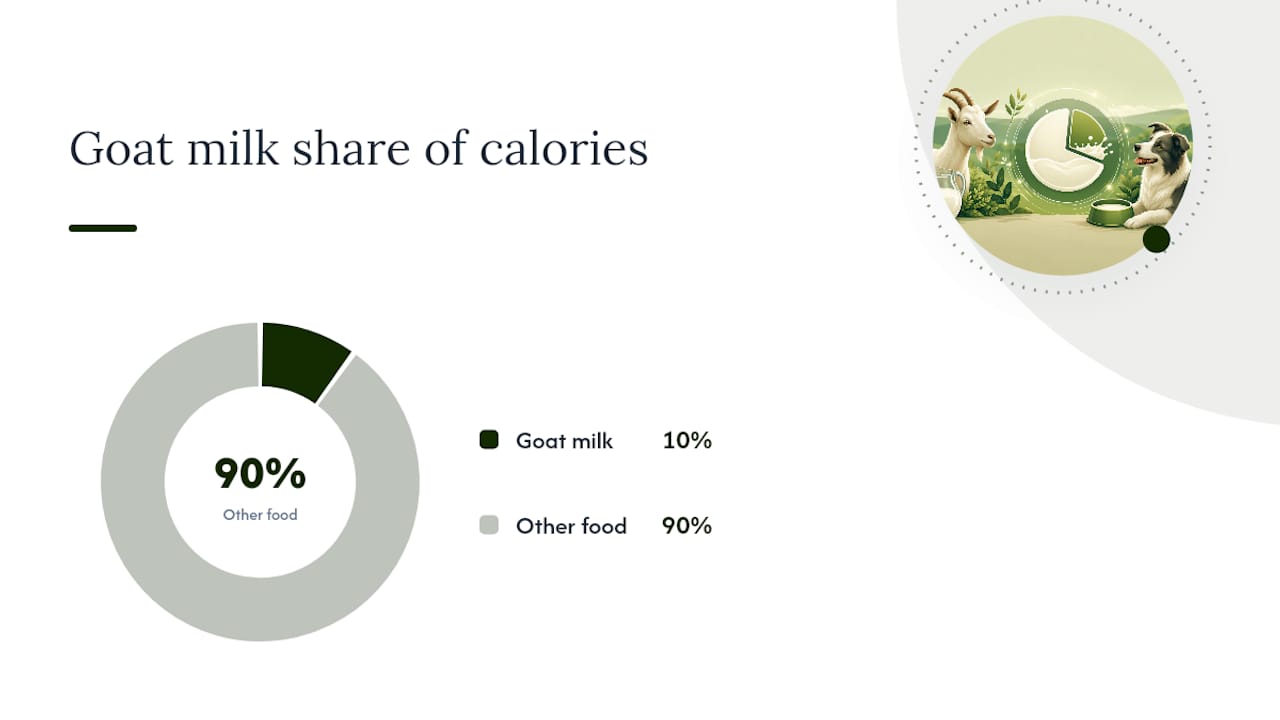
- Keep it to a supplement, not a staple: Goat milk should not exceed roughly 10% of your dog’s daily caloric intake. It is a topper, a treat, or a recovery aid, not a primary food source.
- Frequency: Daily use is fine for dogs that tolerate it well, but a few times per week is plenty for most. Frozen goat milk treats work well as an occasional enrichment option.
If your dog shows no reaction after two weeks of gradual introduction, you can treat it as a regular part of their routine. If symptoms appear at any point, stop and consult your vet before reintroducing.
Which dogs should not have goat milk?
Not every dog is a good candidate. Skip goat milk entirely, or get explicit vet clearance first, if your dog has any of the following:
- Pancreatitis (current or historical): The fat content in goat milk can trigger or worsen pancreatic inflammation. This is a hard contraindication.
- Obesity or calorie-restricted diet: Goat milk adds calories. For a dog already on a weight-management plan, those extra calories work against the goal.
- Diagnosed food allergies: If your dog has a confirmed dairy allergy or sensitivity, goat milk is still dairy. The different protein profile does not eliminate the risk.
- Severe lactose intolerance: Dogs with significant lactase deficiency will react to goat milk just as they would to cow’s milk, even if the reaction is slightly milder.
- Prescription therapeutic diets: Do not substitute or supplement a vet-prescribed therapeutic diet with goat milk without your vet’s knowledge. The therapeutic diet is calibrated for a specific condition.
If your dog is on a prescription diet for kidney disease, liver disease, or a food-elimination trial, adding goat milk without veterinary guidance can undermine the entire treatment plan.
Red-flag symptoms to watch for after any serving:
- Watery or bloody diarrhea
- Repeated vomiting (more than once in a few hours)
- Visible abdominal bloating or signs of pain (hunching, reluctance to move)
- Sudden skin flare, hives, or facial swelling
Any of these warrants stopping goat milk immediately and calling your vet. FirstVet notes that gastrointestinal signs from dairy intolerance can appear within a few hours of feeding, so the 48–72 hour observation window after each increase is not optional.
What forms does goat milk come in and how do owners use it?
The product form you choose affects both convenience and how you use it:
- Pasteurized liquid: The most common form. Pour directly over kibble as a topper, mix into wet food, or offer as a standalone drink. Refrigerate after opening; use within 5–7 days.
- Powdered goat milk: Reconstitute with water per package directions. Longer shelf life before opening, practical for occasional use. Nutritional profile is similar to liquid once reconstituted.
- Kefir/fermented goat milk: Contains live probiotic cultures. Useful for dogs with ongoing digestive sensitivity. Introduce even more slowly than plain goat milk, since the fermentation process changes the flavor and the microbial load.
- Raw goat milk: Carries the pathogen risks described above. Not recommended for most dogs, and particularly not for puppies, seniors, or immunocompromised animals.
Practical uses owners rely on most:
- Kibble topper: A splash of goat milk turns a dry meal into something a picky eater will actually finish.
- Frozen pupsicles: Pour into ice cube trays, freeze, and offer as a warm-weather treat or post-exercise reward.
- Recovery food mixer: Blend with a small amount of wet food for dogs that are nauseous or reluctant to eat after illness or surgery.
- Homemade treat ingredient: Mix into small-batch baked dog treats for added moisture and flavor.
The Honest Kitchen’s pet nutrition resources highlight powdered forms and kefir as practical alternatives for owners who want flexibility in how they use goat milk week to week.
Where can you buy goat milk for dogs in Canada?
Buying goat milk for your dog in Canada is straightforward once you know what to look for. The checklist:
- Pasteurized: Non-negotiable for safety. The label should state it clearly.
- Short ingredient list: For plain goat milk, the only ingredient should be goat milk. Avoid products with added sugars, artificial flavors, or thickeners.
- Sealed packaging with a clear expiry date: Especially important for liquid forms.
- Labeled for human or animal consumption: Either is fine; what matters is the pasteurization and ingredient quality.
Where to find it:
- Grocery stores: Some carry pasteurized goat milk in the dairy aisle, though selection varies by region.
- Pet specialty stores: Often carry goat milk products formulated specifically for pets, including powdered and kefir forms.
- Online: Convenient for powdered forms with longer shelf life.
For dog owners in Orléans and east Ottawa, Petbite carries the Raw Goat Milk Original 975 mL in stock as a local, quality option. Confirm availability and ask the staff any product questions before your first purchase. And as always, check with your vet before starting goat milk, particularly if your dog has any existing health conditions.
A practical perspective on goat milk and responsible use
The conversation around goat milk in the pet world tends to swing between two extremes: either it is a miracle supplement that fixes digestion, joints, skin, and immunity all at once, or it is an unnecessary risk that no dog needs. Neither framing is accurate.
What the evidence actually supports is more useful: goat milk is a palatable, reasonably digestible dairy supplement that works well in specific situations, particularly for recovery, appetite stimulation, and hydration. The claims about joint health, immune support, and skin improvement are plausible but not proven in dogs specifically. That gap between “plausible” and “proven” matters when you are making decisions about your dog’s diet.
The safety question is simpler. Pasteurized beats raw, every time, for every dog. The nutritional difference is negligible; the pathogen risk is not.
At Petbite, the approach is to stock quality products and give owners honest information, not to oversell. The Raw Goat Milk Original 975 mL is a product the team stands behind, and the staff can answer practical questions about how to use it. But the vet conversation comes first.
Petbite’s Raw Goat Milk is available for local pickup and delivery
If you’ve decided goat milk is worth trying for your dog, Petbite makes it easy to get started without a trip across the city. The Raw Goat Milk Original 975 mL is available in-store and online, with free same-day delivery within 3 km of the Orléans location.
Petbite also carries a range of raw frozen pet food options for owners exploring broader raw-feeding approaches, alongside treats and toppers that pair well with a goat milk routine. Consult your veterinarian before starting, then reach out to the Petbite team with any product questions. Order online or stop by the store in Orléans.
Sources
- Goat’s Milk for Dogs: Benefits and Uses | Great Pet Care
- 🥛 Goat Milk for Dogs and Cats: Pawsome Benefits You Need to Know 🐶🐱✨ – Ask A Vet
- Shelter Medicine and Community Engaged Care – UW–Madison
- Goat’s Milk for Dogs | Dogster
This article is general information, not a substitute for advice from a qualified doctor. Consult a qualified healthcare professional about your own circumstances before acting on anything here.