

Raw dog food poses documented health risks from pathogen contamination, and the official position of Canadian veterinary authorities is clear: the risks outweigh the benefits. The Canadian Veterinary Medical Association (CVMA) recommends against feeding raw meat-based diets to pets, citing compelling evidence of harm from Salmonella, Listeria, and E. coli to both animals and the people who live with them. If you are already feeding raw or seriously considering it, here is what you need to know before the next meal hits the bowl.
Key risks and official advisories at a glance:
- Raw dog food frequently contains dangerous pathogens, including Salmonella spp., Listeria monocytogenes, and E. coli, that can sicken both dogs and humans.
- The CVMA and the Public Health Agency of Canada caution against raw meat-based diets for pets.
- Dogs can shed pathogens asymptomatically, meaning a healthy-looking dog can still transmit illness to household members.
- Canada’s Food Inspection Agency does not regulate domestic raw pet food for pathogen testing or nutritional adequacy.
- Children, elderly people, pregnant individuals, and anyone with a compromised immune system face the highest risk from exposure.
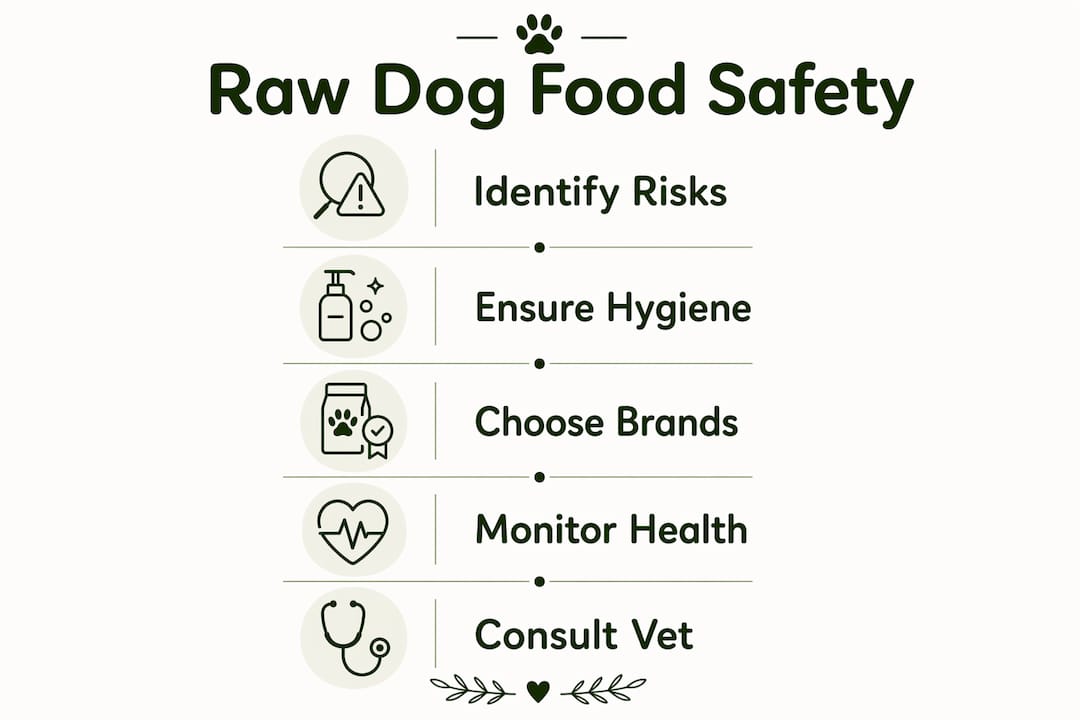
- If you choose to feed raw, strict hygiene protocols and sourcing from quality-controlled manufacturers are non-negotiable steps.
Table of Contents
- What are the real health risks of raw dog food safety?
- What do Canadian veterinary and regulatory bodies say?
- Is raw dog food nutritionally complete?
- How to handle raw dog food safely at home
- Trusted Canadian raw dog food brands you can buy locally
- Where Petbite fits into your raw feeding plan
- Key Takeaways
What are the real health risks of raw dog food safety?
Pathogen contamination is the central concern with raw pet food, and the numbers are not reassuring. Studies have found Salmonella spp. in up to 26.2% of sampled raw meat-based diets, and Listeria monocytogenes in up to 19% of samples. An FDA Center for Veterinary Medicine study found a substantial chance of encountering a foodborne pathogen in frozen raw meat pet diets purchased online.
Beyond the headline bacteria, raw diets have also been linked to antibiotic-resistant bacteria, including multidrug-resistant E. coli strains. These are not just harder to treat in your dog. The genes encoding that resistance can spread to other bacteria in the gut microbiome of both pets and humans, potentially undermining future antibiotic treatments for entirely unrelated infections.
The zoonotic risk is where many pet owners get caught off guard. A dog does not need to look or act sick to shed Salmonella in its feces or saliva. A large epidemiologic study published in 2017 found that raw meat consumption was a significant risk factor for Salmonella shedding in dogs, and close to half of infected dogs appeared completely healthy. That means face licks, shared spaces, and unwashed hands after petting can all become transmission routes.
| Pathogen | Prevalence in raw pet food | Primary risk |
|---|---|---|
| Salmonella spp. | Up to 26.2% of samples | Gastrointestinal illness in dogs and humans; zoonotic transmission |
| Listeria monocytogenes | Up to 19% of samples | Severe illness in immunocompromised individuals; miscarriage risk |
| E. coli (including ESBL-producing strains) | Present; antibiotic-resistant strains documented | Treatment-resistant infections in pets and humans |
Contamination scale: An FDA study on raw pet food found roughly a 1-in-3 chance of pathogen exposure from frozen raw meat diets purchased online, covering Salmonella, Listeria, or toxigenic E. coli.
High-risk household members face the sharpest danger. Children under five, adults over 65, pregnant people, and anyone on immunosuppressive medication can develop severe or life-threatening illness from pathogens that might cause only mild symptoms in a healthy adult. Feeding raw in a household with any of these individuals requires an especially hard look at whether the practice is worth continuing.
What do Canadian veterinary and regulatory bodies say?
The CVMA’s position is unambiguous. The association recommends against feeding raw meat-based diets, stating that the evidence of health risks from pathogens affecting both pets and humans is compelling, and that those risks outweigh any purported benefits.
“The CVMA recommends against feeding raw meat-based diets to pets because of the potential health risks to pets and to the humans who handle these products and come into contact with pets consuming these diets.” — Canadian Veterinary Medical Association position statement
On the regulatory side, the picture is more complicated, and not in a reassuring way. Canada’s Food Inspection Agency (CFIA) does not regulate domestic raw pet food for safety or nutritional adequacy. Its oversight is largely limited to import and export certification. There is no mandatory pathogen testing requirement and no national standard for nutritional completeness in raw pet foods sold within Canada. That regulatory gap means the safety of any given product depends almost entirely on what the manufacturer chooses to do voluntarily.
What this means in practice for Canadian pet owners:
- Your vet’s advice to avoid raw feeding is backed by the national veterinary association, not just individual opinion.
- A raw pet food product sold in Canada has not necessarily been tested for Salmonella, Listeria, or E. coli before reaching store shelves.
- Nutritional claims on raw pet food packaging are not verified by a federal body.
- Asking manufacturers directly about their pathogen testing protocols and whether a qualified animal nutritionist formulated the recipe is the only way to get that information.
- The CFIA’s import controls do not translate into domestic production standards.
The scientific consensus, as Cornell University’s Riney Canine Health Center notes, strongly advises against raw feeding because of documented bacterial hazards and the absence of effective kill steps in manufacturing. Cooking is the only reliable method for eliminating these pathogens.
Is raw dog food nutritionally complete?
The short answer is: usually not, without careful supplementation. The 80-10-10 model, which calls for 80% muscle meat, 10% raw bone, and 10% organ meat, is the most widely cited framework in raw feeding communities. It is a starting point, not a finished diet. Without targeted additions, it leaves meaningful nutritional gaps.
Long-term feeding of an unbalanced raw diet can lead to deficiencies in vitamin D, iodine, manganese, and omega-3 fatty acids. These are not minor gaps. Vitamin D supports calcium metabolism and bone density. Iodine is required for thyroid function. Manganese plays a role in joint health and enzyme activity. Omega-3 fatty acids affect skin, coat, and inflammatory response. Puppies and large-breed dogs are especially vulnerable because deficiencies during growth phases can cause skeletal deformities and developmental problems that are difficult or impossible to reverse.
Feeding and supplementation considerations for raw diets:
- Work with a board-certified veterinary nutritionist, not just online calculators or community forums, to formulate a balanced recipe.
- The 80-10-10 ratio requires supplementation with vitamin D, iodine, manganese, and essential fatty acids at minimum.
- Rotate protein sources (beef, rabbit, salmon, poultry) to reduce the risk of single-nutrient deficiencies.
- Puppies, pregnant or nursing dogs, and senior dogs have higher nutritional demands and face greater risk from imbalanced diets.
- Have your dog’s bloodwork checked at least annually if feeding raw, so deficiencies can be caught before they cause clinical symptoms.
- Freeze-dried and dehydrated raw products carry the same nutritional considerations as fresh raw, and the same pathogen risks.
How to handle raw dog food safely at home
Safe handling does not eliminate the risk of pathogen exposure, but it reduces it meaningfully. The Government of Quebec’s raw feeding guide and Cornell’s Riney Canine Health Center both recommend treating raw pet food exactly as you would raw meat intended for human consumption, with the same level of care and the same assumption that contamination is possible.

Pro Tip: Even if your dog shows no signs of illness, treat every post-feeding interaction as a potential exposure event. Wash your hands with soap and water for at least 20 seconds after handling raw food, after feeding, and after any contact with your dog’s mouth or feces.
Safe handling and storage practices:
- Keep raw food frozen until 24 hours before use, then thaw in the refrigerator, never on the counter.
- Store raw pet food in sealed containers on the lowest refrigerator shelf, away from human food, to prevent drip contamination.
- Use dedicated cutting boards, bowls, and utensils for raw pet food and never mix them with your kitchen tools.
- Wash and sanitize all surfaces that contact raw food, including the feeding bowl and the floor around it, after every meal.
- Do not let your dog lick your face, hands, or open wounds after eating raw food.
- Keep children and high-risk household members away from the feeding area during and immediately after meals.
- Wash your hands after petting your dog, not just after handling the food itself, since pathogen shedding through saliva and feces is an ongoing risk.
- Do not rinse raw meat in the sink, as splashing spreads bacteria across surfaces.
- Discard any uneaten raw food after 30 minutes rather than leaving it in the bowl.
Watch for signs of foodborne illness in your dog: vomiting, diarrhea (especially bloody), lethargy, or loss of appetite. If any of these appear after starting or changing a raw diet, contact your veterinarian and mention the dietary change specifically.
Trusted Canadian raw dog food brands you can buy locally
Given the regulatory gaps in Canada, sourcing from manufacturers who voluntarily apply rigorous quality controls matters more than it would in a more tightly regulated market. The brands that earn trust are the ones that test for pathogens, work with qualified nutritionists, and are transparent about their sourcing and production processes. Commercial raw pet food quality varies widely, so asking manufacturers directly about their testing protocols is a reasonable and worthwhile step.
Iron Will Raw is one of the Canadian brands that Petbite stocks, and it offers a range of single-protein options worth knowing:
- Iron Will Raw Basic Rabbit (6 lb frozen): A single-protein option well-suited for dogs with food sensitivities or those rotating proteins to reduce deficiency risk. Rabbit is a lean, novel protein that many dogs tolerate well.
- Iron Will Raw Basic Salmon (4 lb frozen): Salmon provides a natural source of omega-3 fatty acids, one of the nutrients most commonly deficient in raw diets. Rotating salmon into the feeding schedule addresses that gap more directly than supplementation alone.
- Iron Will Raw Basic Beef (6 lb frozen): A foundational protein option for dogs already accustomed to beef-based diets. Beef is calorie-dense and works well as a base protein in a rotation plan.
When evaluating any raw pet food brand, ask whether the product was formulated by a veterinary nutritionist, whether the manufacturer tests finished products for Salmonella and Listeria, and whether the sourcing is traceable. A brand that cannot answer those questions clearly is one to approach with caution.

Where Petbite fits into your raw feeding plan
Feeding raw responsibly takes more than good intentions. It takes access to quality-controlled products, reliable sourcing, and the kind of guidance you do not get from a big-box shelf.
Petbite, located in Orléans, specializes in premium raw pet food and stocks trusted Canadian brands including Iron Will Raw. Unlike large chain retailers, Petbite carries a curated selection and the staff knowledge to match. If you are transitioning your dog to raw, or looking to tighten up your current feeding routine with better-sourced products, Petbite offers free same-day delivery within 3 kilometers of its Orléans location, so you can get quality food to your door without a trip to the store. Browse the Iron Will Raw Basic Rabbit and Iron Will Raw Basic Salmon options currently available, or visit petbite.ca to see the full raw food selection and place an order today.
Key Takeaways
Raw dog food carries pathogen risks that affect both pets and the humans in the household, and handling protocols can reduce but not entirely eliminate that risk.
| Point | Details |
|---|---|
| Pathogen prevalence is high | Studies found Salmonella in up to 26.2% and Listeria in up to 19% of raw pet food samples. |
| CVMA advises against raw feeding | Canada’s national veterinary association recommends against raw meat-based diets due to documented health risks. |
| No federal safety standard in Canada | The CFIA does not require pathogen testing or nutritional verification for domestically sold raw pet food. |
| Nutritional gaps require active management | The 80-10-10 model is incomplete without supplementation of vitamin D, iodine, manganese, and omega-3 fatty acids. |
| Petbite stocks quality-controlled options | Petbite in Orléans carries Iron Will Raw Basic Rabbit, Salmon, and Beef, with free same-day delivery within 3 km. |