

For most households, raw bones are not a routine dental treat. They’re a high-risk, supervised option that veterinary organizations — including the Canadian Veterinary Medical Association — actively discourage for most pet owners. If you’re weighing the dental benefit claims against real-world risks, here’s the short version: the risks are significant, the dental evidence is limited, and safer alternatives exist.
Quick signals: is a raw bone right for your dog right now?
- ✅ Adult dog, experienced chewer, no dental disease, no GI history
- ✅ Household with no children, pregnant, elderly, or immunocompromised members
- ❌ Puppies, seniors, aggressive gulpers, dogs with repaired teeth or pancreatitis history
- ❌ Anyone who can’t supervise the full chewing session
Pro Tip: Before offering any bone, press your thumbnail firmly into it. If you can’t leave a dent, the bone is too hard for safe chewing and risks fracturing a tooth.
Table of Contents
- What do veterinarians actually say about raw bones?
- Which bones carry lower risk, and which should you avoid?
- How to give a raw bone safely: the step-by-step checklist
- Which dogs and households should skip raw bones entirely?
- How Petbite supports safe raw choices in Orléans
- Key Takeaways
- A safety-first perspective on raw bones
- Raw bones and dental health: get the right product from Petbite
- Useful sources and further reading
What do veterinarians actually say about raw bones?
The claimed benefits are real but narrow. A small Beagle study published in PLOS ONE found that raw bovine bones reduced dental calculus over 20 days in eight dogs, but the evidence quality is low and results do not generalize to all breeds or chewer types.
The risks, by contrast, are well-documented across clinical practice.
Main risks veterinarians cite:
- Tooth fractures (carnassial fractures): hard bones crack the large upper premolars, often requiring extraction or specialist referral
- Choking and esophageal obstruction: bones account for 30–80% of esophageal foreign bodies in dogs seen in veterinary practice
- GI perforation or obstruction: sharp bone fragments can pierce the intestinal wall, requiring emergency surgery
- Bacterial contamination: Salmonella and antimicrobial-resistant E. coli shed rates are higher in raw-fed dogs, creating household infection risk
Bones do not replace professional dental care. Daily brushing, professional cleanings, and Veterinary Oral Health Council (VOHC)-accepted chews are the evidence-backed standard for canine oral health. A single tooth fracture can cost more to treat than years of professional cleanings.
| Risk category | Likelihood | Consequence |
|---|---|---|
| Tooth fracture | Moderate to high (hard bones) | Pain, extraction, specialist referral |
| Choking / esophageal obstruction | Moderate | Emergency vet, endoscopy or surgery |
| GI perforation / obstruction | Lower but serious | Emergency surgery, potentially fatal |
| Bacterial contamination | Moderate | Illness in dog and household members |
| Nutritional excess (marrow fat) | Low to moderate | GI upset, pancreatitis risk in susceptible dogs |
Pro Tip: Dogs eating a complete, balanced commercial diet don’t need bones for nutrition. Marrow adds significant fat — a problem for any dog with a pancreatitis history.
Which bones carry lower risk, and which should you avoid?
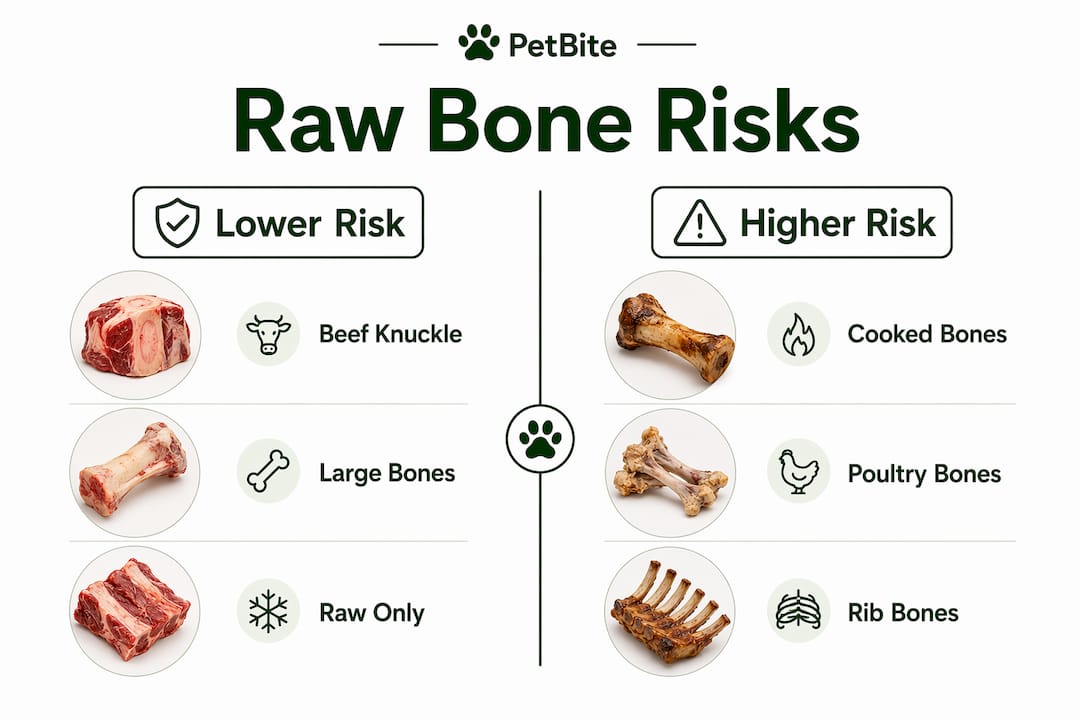
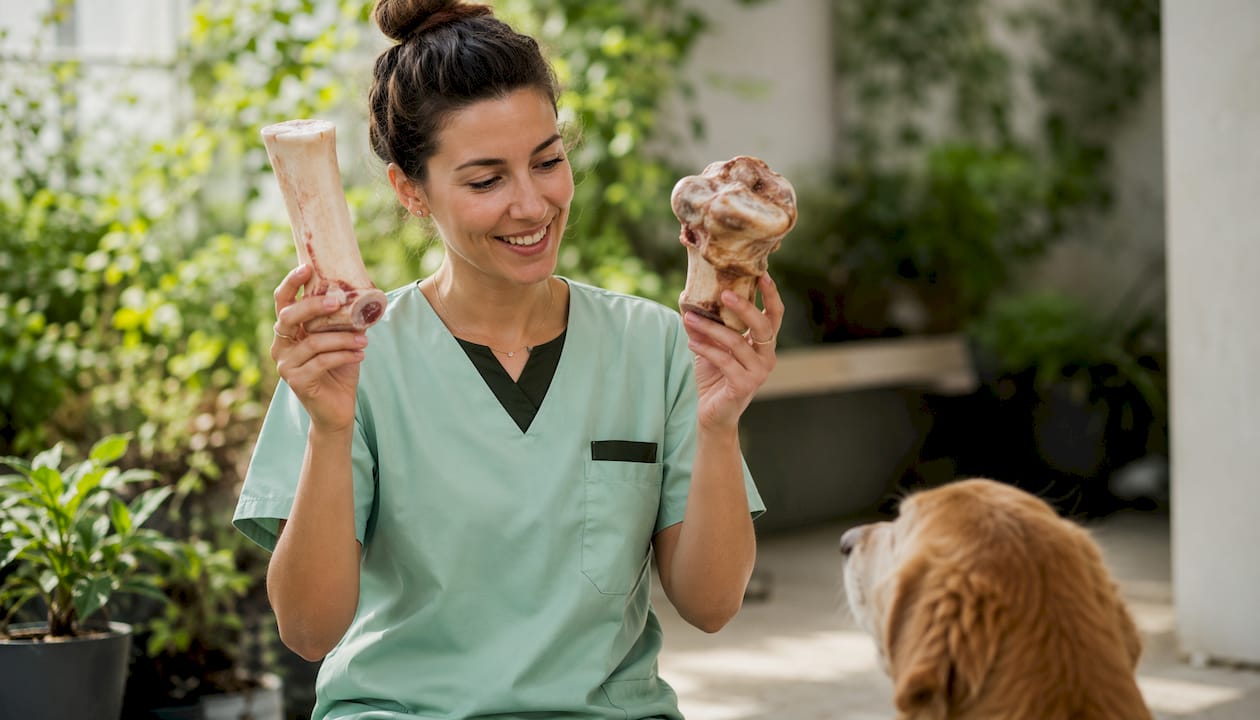
The single most important rule: always raw, never cooked. Cooking changes bone structure, making it brittle and prone to splintering into sharp shards. Raw bones are softer and less likely to splinter — but they still fracture teeth and carry pathogens.
| Bone type | Risk level | Best for | Nutritional note | Prep / storage |
|---|---|---|---|---|
| Large raw marrow bone (beef) | Moderate | Large, moderate chewers | High fat in marrow; pancreatitis risk | Refrigerate; discard after 4 days |
| Flat rib bone (raw beef) | Moderate | Medium to large dogs | Lower marrow, some meat attached | Refrigerate; discard after 4 days |
| Raw poultry bones (chicken, turkey) | High | Not recommended for most dogs | Hollow; splinter and perforate easily | Avoid for medium/large dogs |
| Weight-bearing beef bones (femur, knuckle) | High | Avoid for all dogs | Dense; fractures teeth | Skip entirely |
| Raw rabbit or duck bones | Lower to moderate | Small to medium dogs | Softer bone structure | Refrigerate; handle like raw poultry |
Safer if:
- The bone is significantly larger than your dog’s muzzle
- Your dog is a moderate chewer, not an aggressive gulper
- You can supervise the entire session
Avoid if:
- The bone passes the thumbnail hardness test (can’t dent it, skip it)
- The bone has become small enough to fit entirely in the dog’s mouth — retire it immediately
- The bone is any poultry type for a medium or large dog
Pro Tip: The San Francisco SPCA specifically flags poultry and rib bones as high-risk items. If you’re unsure about a bone type, that’s a reasonable default to follow.
How to give a raw bone safely: the step-by-step checklist
If you decide to proceed, follow these rules without shortcuts.
- Choose the right bone. Pick a raw bone significantly larger than your dog’s head. Avoid weight-bearing beef bones and all poultry bones for medium or large dogs.
- Thaw properly. Thaw in the refrigerator overnight, never on the counter. Never microwave.
- Run the thumbnail test. Press your thumbnail into the bone. No dent = too hard. Set it aside.
- Offer after a meal. A dog that isn’t hungry chews more slowly and deliberately, reducing gulping risk.
- Supervise the entire session. Never leave a dog alone with a bone. Limit sessions to 15–20 minutes, two to three times weekly or less.
- Separate from other pets and children. Resource guarding around high-value items is common; managing multi-dog households during chew sessions prevents conflict and injury.
- Retire the bone on time. The moment a bone becomes small enough to swallow, discard it immediately.
Hygiene protocol:
- Use a dedicated cutting board for raw bones only
- Wash hands thoroughly after handling
- Store in a sealed container in the refrigerator
- Discard after four days refrigerated; treat raw bones like raw poultry for all surface and utensil hygiene
Emergency actions:
- Choking signs: pawing at mouth, gagging, distress, blue-tinged gums. Call your vet or emergency clinic immediately.
- Suspected GI obstruction: vomiting, lethargy, bloating, bloody stool after bone consumption. This is an emergency — don’t wait.
- Tooth fracture: visible crack, reluctance to eat, pawing at face. Book a vet appointment the same day.
Pro Tip: Skip marrow bones entirely for any dog with a pancreatitis history. The fat load from marrow can trigger a flare even in a single session.
Which dogs and households should skip raw bones entirely?
Some dogs and living situations make raw bones a clear no. The list is longer than most people expect.
Avoid raw bones if your dog is:
- A puppy (developing teeth fracture easily)
- A senior with worn or brittle teeth
- Diagnosed with dental disease, repaired teeth, or crowns
- A known aggressive gulper or resource guarder
- Managing GI disease, pancreatitis, or a compromised immune system
Avoid raw bones if your household includes:
- Children under 5
- Pregnant individuals
- Elderly family members
- Anyone immunocompromised (chemotherapy, organ transplant, HIV)
For these dogs and households, safer dental health options deliver real results without the risk.
Evidence-backed alternatives:
- Daily tooth brushing with a dog-safe enzymatic toothpaste — the gold standard for plaque control
- Professional dental cleanings under anesthesia — the only way to address subgingival tartar
- VOHC-accepted dental chews — look for the VOHC seal; these have passed controlled trials for plaque or tartar reduction
- Rubber stuffable toys and food puzzles — mental enrichment without fracture or obstruction risk
- Low-risk dental treats such as grain-free crunchy treats that support chewing without hard-bone hazards
Petbite stocks safer chew options alongside its raw inventory. If you’re unsure what fits your dog’s needs, the staff can point you toward VOHC-compatible choices before you commit to anything.
How Petbite supports safe raw choices in Orléans
Petbite’s Orléans location carries a curated selection of raw bones and raw food products, chosen with handling and safety in mind. For owners who have weighed the risks and decided to proceed, here’s what’s currently in stock and how each fits the safety checklist.
In-stock raw items at Petbite:
- Large Marrow Bone (2 lb) — suited to large, moderate chewers; high marrow fat content means it’s not appropriate for pancreatitis-prone dogs
- Flat Rib Bone — lower marrow content, some meat attached; good for medium to large dogs who pass the thumbnail test
- Iron Will Raw Basic Beef — frozen raw complete food, not a bone, but a useful complement for owners building a raw feeding routine
- Iron Will Raw Basic Chicken — frozen raw chicken base; handle with the same hygiene standards as raw bones
- Iron Will Raw Basic Rabbit — softer protein source, often a better fit for smaller dogs or those new to raw
All raw products are stored cold and handled through a proper cold chain. Petbite offers free same-day delivery within 3 km of the Orléans store, so you can get fresh raw items without compromising temperature control during transport.
Pro Tip: Ask Petbite staff which bone size fits your dog’s breed before purchasing. Getting the size wrong is the most common mistake first-time raw bone buyers make.
Key Takeaways
Raw bones carry real veterinary risks that outweigh their limited dental benefits for most dogs, and safer alternatives like daily brushing and VOHC-accepted chews should be the first choice for canine oral health.
| Point | Details |
|---|---|
| Limited dental evidence | A small Beagle study showed tartar reduction over a short term; results don’t generalize to all breeds or chewer types. |
| Obstruction risk is serious | Bones represent a substantial share (30–80%) of esophageal foreign bodies in dogs treated in veterinary practice. |
| Cooked bones always higher risk | Cooking makes bones brittle and prone to splintering; always raw if you proceed, never cooked. |
| Clear exclusion list | Puppies, seniors, gulpers, and households with vulnerable members should avoid raw bones entirely. |
| Petbite local option | Petbite in Orléans stocks Large Marrow Bone, Flat Rib Bone, and Iron Will Raw lines with same-day delivery within 3 km. |
A safety-first perspective on raw bones
The debate around raw bones tends to get framed as “natural vs. processed” — and that framing does real harm. Wild canids chew bones, yes. They also break teeth, develop infections, and die from intestinal perforations at rates we don’t see in well-managed domestic dogs. “Natural” is not a safety standard.
What actually matters is the specific dog in front of you: their chewing style, dental history, household composition, and your ability to supervise. For a large, healthy, moderate-chewing adult dog in a household without vulnerable members, a properly sized raw bone offered two to three times a week under close supervision is a manageable risk. For everyone else, the math doesn’t work.
Petbite’s position is straightforward: stock quality raw products for owners who make an informed choice, give honest guidance about risk, and make sure safer alternatives are always on the shelf too. This article is harm-reduction guidance, not an endorsement to feed bones routinely. Before trying raw bones, talk to your vet — and if you decide to proceed, talk to Petbite staff about sizing and handling.
Raw bones and dental health: get the right product from Petbite
If you’ve read this far and decided a raw bone is appropriate for your dog, Petbite makes it straightforward to get the right one. The Orléans store carries the Large Marrow Bone for large moderate chewers, the Flat Rib Bone for medium to large dogs, and Iron Will Raw complete meals including Basic Beef and Basic Rabbit for owners building a broader raw routine.
Free same-day delivery is available within 3 km of the Orléans location — cold chain intact, no trip required. Staff can help you match bone size to your dog’s breed and chewing style before you buy. Visit petbite.ca or contact the store directly to ask about current stock and get a recommendation tailored to your dog.
Useful sources and further reading
- Raw beef bones and dental calculus — PubMed: The primary peer-reviewed Beagle study on tartar reduction from raw bovine bones.
- Should dogs eat raw bones? — The Canine Dietitian: Evidence-based nutritionist review covering obstruction rates, hygiene, and household risk.
- Can dogs eat bones? — Purina: Accessible overview of bacterial contamination risk and nutritional considerations.
- What bones can dogs eat? — San Francisco SPCA: Animal welfare guidance with specific high-risk bone type callouts.
- Guidelines for feeding raw bones — The Nutrition Vet: Frequency, session length, sizing, and retirement criteria from a clinical perspective.
- What kinds of bones can dogs eat? — Dogster: Practical field tests including the thumbnail hardness check.
- Dog bone safety — Guilford Jamestown Vet: Veterinary perspective on fracture risk versus dental benefit.
- Risks and benefits of raw meat-based diets — Alberta Animal Health Source / JAVMA: Peer-reviewed JAVMA review; includes CVMA and AVMA position statements.
- Dental chew alternatives — Happy-Dog Training: Reviews dentist-recommended dental care methods and enrichment alternatives to raw bones.
- Petbite — Orléans raw food and bone inventory: Local source for cold-chain raw products with same-day delivery and in-store staff guidance.
Recommended
- Iron Will Raw Basic Beef Frozen Raw Pet Food for Dogs & Cats 6lb - Petbite
- Iron Will Raw Basic Rabbit Frozen Raw Pet Food for Dogs & Cats 6lb - Petbite
- Iron Will Raw Basic Chicken Frozen Raw Pet Food for Dogs & Cats 6lb - Petbite
- Charlee Bear Grain Free Crunch Beef & Cheese Flavor Crunchy Dog Treats 8oz - Petbite