

Give most adult dogs 4 to 6 weeks to move from kibble to raw. That single decision prevents more vomiting, diarrhea, and panicked vet calls than any other choice you’ll make during the switch. A faster 10 to 21 day ramp can work for young, tolerant dogs with no digestive history, but it carries a real cost: more gastrointestinal upset along the way. Either path lives or dies on one metric: stool quality. Firm, well-formed stool means keep going. Loose, watery, or bloody stool means hold the current ratio or step back to the last one that worked.
Three things you can do today, before you buy a single ounce of meat:
- Pick a complete and balanced commercial raw diet, or line up a veterinary nutritionist if you’re building a homemade plan from scratch.
- Set fixed meal times instead of free-feeding. Raw food sitting out invites bacteria, and a schedule makes stool changes easier to track.
- Stock basic hygiene supplies: dedicated cutting boards, a food-safe thermometer, and a plan for where frozen raw gets stored and thawed.
Pro Tip: The single most common mistake owners make isn’t a bad protein choice or the wrong ratio. It’s rushing. A dog that’s eaten dry kibble for five years has a gut microbiome and stomach acid level calibrated to that food. Give it weeks, not days, to recalibrate.
Key Takeaways
A conservative 4 to 6 week transition, tracked by stool quality, gives most dogs and cats the smoothest, safest path from kibble to a fully raw diet.
| Point | Details |
|---|---|
| Choose your timeline | Use 4 to 6 weeks for most adult dogs; reserve the 10 to 14 day plan for young, tolerant dogs with no GI history. |
| Track stool, not the calendar | Firm stool means advance; loose stool beyond 3 to 4 days means hold or step back a ratio. |
| Handle raw food safely | Dedicated cutting boards, hand washing, and a 15 to 20 minute room-temperature limit prevent pathogen exposure. |
| Know when to call the vet | Blood in stool, repeated vomiting, or lethargy are urgent signs, not wait-and-see ones. |
| Favor complete commercial diets | A commercial raw formula with an AAFCO completeness statement removes most of the formulation risk a DIY recipe carries unless a DACVN has approved the recipe. |
| Start with Petbite | Petbite’s Iron Will Raw line offers single-protein starter formulas with same-day local delivery for a lower-risk first transition. |
Pro Tip: Book a vet check within the first three months of a full switch, and keep weighing your pet every two weeks until you’re confident the portions are dialed in correctly.
Table of Contents
- How Does an Immediate Switch to Raw Dog Food Work?
- What Is the Best Gradual Transition Schedule?
- How Is Switching Cats to Raw Different From Dogs?
- What Should You Expect During the Switch?
- How Do You Handle Raw Food Safely at Home?
- How Much Should You Feed During and After the Switch?
- What Should You Do If Something Goes Wrong?
- Why Does a Slower Transition Actually Work Better?
- What Do We See Working (and Failing) at Petbite?
- How Can Petbite Help You Get Started?
- Where Can You Learn More About Raw Feeding?
- Frequently Asked Questions
- Sources
How Does an Immediate Switch to Raw Dog Food Work?
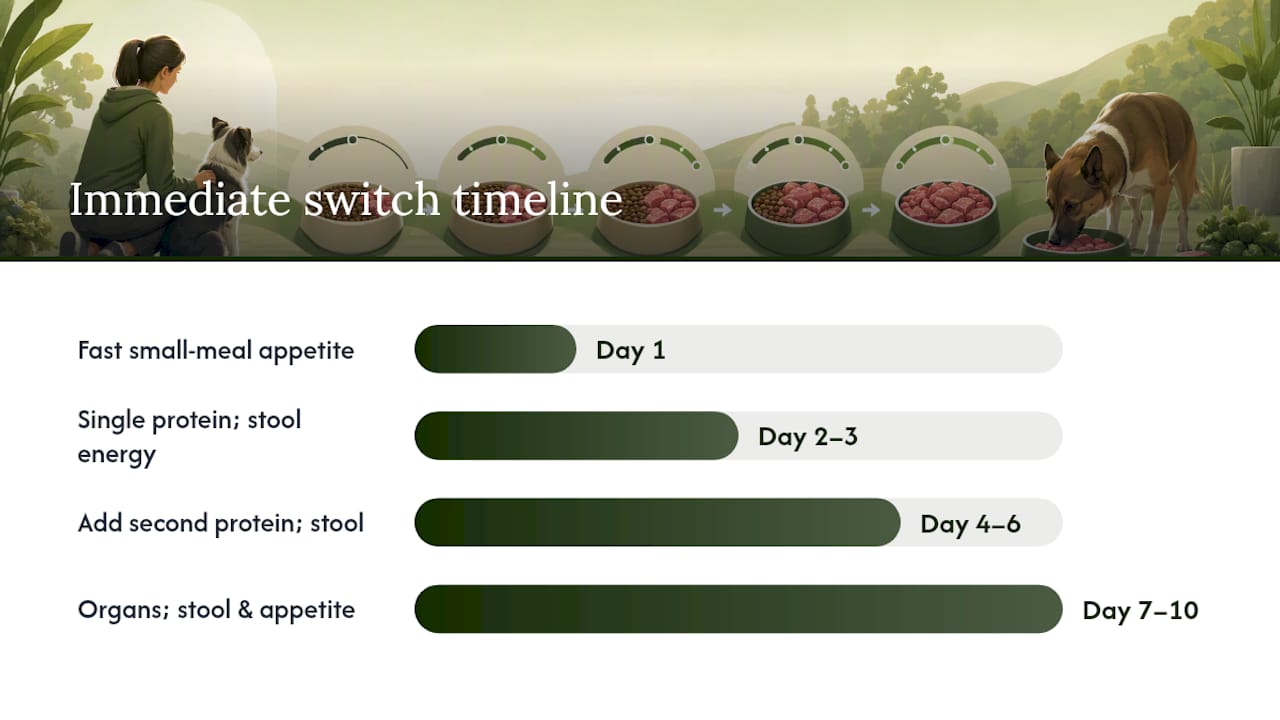
An immediate or rapid switch means dropping kibble entirely and starting raw within a matter of days rather than weeks. It’s not reckless if you pick the right dog for it, but it’s not the default either.
This method fits a narrow profile: young, healthy, active dogs with no history of digestive sensitivity, no chronic illness, and ideally some prior exposure to varied proteins (not a dog that’s eaten the same single-source kibble its whole life). Senior dogs, puppies under 12 weeks, and any dog with a history of pancreatitis or IBD should skip this route entirely and use the gradual plan instead.
| Day | Action | What to watch for |
|---|---|---|
| Day 1 | Fast for 12 to 24 hours (adult dogs only), then serve a small raw meal, roughly half the normal portion | Appetite and enthusiasm for the new texture |
| Day 2–3 | Move to full portion of a single protein source | Stool consistency, energy level |
| Day 4–6 | Introduce a second protein if the first is well tolerated | Any softening of stool beyond mild |
| Day 7–10 | Add organ meat in small amounts (5 to 10% of the meal) | Stool color changes, appetite dips |
Before starting, weigh your dog and write it down. A quick weight check two weeks in tells you whether the new diet is meeting caloric needs. If you plan to use probiotics or digestive enzymes, start them 5 to 7 days before the first raw meal so gut flora has a head start, a practical tactic experienced raw feeding protocols recommend for exactly this scenario.
Stop and call your veterinarian if you see repeated vomiting, diarrhea lasting more than 48 hours, blood in the stool, or a dog that refuses food for more than one full day. Shorter transition windows genuinely do work for some dogs, but a rushed 10 to 14 day plan applied to a long-term kibble eater is the most common reason owners end up back on the phone with their vet within the first week.
What Is the Best Gradual Transition Schedule?
If you’re switching dog from kibble to raw and want the lowest-risk path, this is it. Two templates work well, depending on how much patience you have and how sensitive your dog’s stomach tends to be.
The 7 to 14 day plan
This works for dogs with reasonably tough stomachs and no prior GI history. It moves faster than the 4 to 6 week option, so watch stool quality closely at every jump.
The 4 to 6 week plan (the safer default)
A six-week ramp that starts around 10% raw and climbs gradually gives the gut microbiome and stomach acidity time to adjust, which is why it’s increasingly the recommended default for kibble-fed adults rather than a compressed one to two week switch.
That weekly progression, drawn from a widely used six-week beginner plan, gives most dogs enough runway to avoid the vomiting and diarrhea that a faster switch can trigger.
Working the math: for a 20-pound dog eating 2% of body weight daily, that’s 6.4 ounces of total food per day. During Week 1 of the six-week plan, roughly 0.64 ounces of that comes from raw, with the rest still kibble. By Week 4, you’re splitting it evenly: about 3.2 ounces raw, 3.2 ounces kibble.
Hold-rule checklist:
- Stool still firm and well-formed after 3 days at the new ratio? Advance to the next step.
- Stool soft but formed? Hold at the current ratio for 3 more days before advancing.
- Stool watery, or your dog vomits more than once? Step back to the last ratio that produced solid stool and stay there for a full week.
- Blood in stool or repeated vomiting? Stop advancing and call your vet before doing anything else.
Pro Tip: Serve raw food closer to room temperature during the first two weeks. Cold-from-the-fridge meat straight into an adjusting stomach can make mild GI upset worse than it needs to be, and slightly warmer food is also more appealing to a dog still deciding if it likes the new texture.
How Is Switching Cats to Raw Different From Dogs?
Cats are not small dogs about this, and treating the transition the same way is the fastest route to a cat that simply refuses to eat. Cats imprint on food textures and flavors early in life, which narrows their willingness to accept something new far more than it does in most dogs. They also get less water from their food than you’d think matters, until a cat used to a specific texture stops drinking enough and you’re dealing with a second problem on top of the diet switch.
Slower is almost always the answer with cats. Start with a single protein rather than variety, since a cat overwhelmed by an unfamiliar smell and an unfamiliar new protein at the same time is a cat that walks away from the bowl. Warming the food to near body temperature (test on your wrist, never microwave it) mimics the temperature of fresh prey and meaningfully improves acceptance in cats that are otherwise hesitant. Never microwave raw meals to warm them. Uneven heating leaves cold spots and hot spots and can make small bone fragments brittle in unpredictable ways.
If your cat is a committed dry-food eater, moving to a canned or wet formula like PetKind Canada Fresh Salmon Formula style textures first, before raw, often smooths the path. Scheduled meals beat free-feeding here: a cat that grazes all day never gets hungry enough to try something unfamiliar, while a cat on set meal times is more motivated to eat what’s in front of it.
What to avoid: dairy (many cats are lactose intolerant and it adds nothing nutritionally), and switching proteins too quickly in the early weeks, which resets the acceptance process you just built. A three- to four-week timeline works for many cats, but older or more sensitive cats can reasonably need 5 to 6 weeks. If your cat refuses raw food entirely after two consistent weeks of small, patient attempts, or shows any weight loss, that’s your signal to loop in a veterinarian rather than pushing further alone.
Pro Tip: Never let a cat go more than 24 hours without eating anything. Unlike dogs, cats risk a serious liver condition called hepatic lipidosis when they stop eating for even a short stretch, so patience during a raw transition still has a hard limit.
What Should You Expect During the Switch?
The first week usually brings some softening of stool and maybe a little extra gas as the gut adjusts. That’s expected, not a failure of the plan. What happens next, and how long it lasts, follows a fairly predictable pattern.
Week 1: mild stool softening, possibly some gas, occasional decreased appetite as the pet adjusts to new textures and smells.
Weeks 2 to 4: stool should be firming up again at each ratio increase. Energy levels often tick upward. Some owners notice their pet’s breath changes (usually for the better, since raw diets don’t leave the starchy residue kibble does).
After fully switched: firmer, smaller stools become the new normal (raw diets are more digestible, so less waste comes out the other end), a shinier coat within 4 to 8 weeks, and steadier energy. Some owners describe an early “detox” period of looser stool or minor skin flaking in week one or two. That’s a real, temporary adjustment phase, not something to panic over, as long as it resolves within a few days.
| Stool type | What it means | Action |
|---|---|---|
| Firm, well-formed | Ratio is working | Advance to next step |
| Soft but holds shape | Still adjusting | Hold current ratio 2 to 3 more days |
| Loose or watery | Ratio too aggressive | Step back one ratio, stabilize a week |
| Blood present | Possible injury or infection | Stop, call vet |
| White, crumbly, hard | Too much bone content | Reduce bone ratio immediately |
Red flags that mean stop and call your vet, not just slow down: blood in the stool, watery diarrhea lasting more than 48 to 72 hours, repeated vomiting (more than twice in a day), or a dog or cat that seems lethargic and uninterested in normal activity. Persistent loose stool beyond three to four days is the threshold where “still adjusting” turns into “something’s wrong.”
How Do You Handle Raw Food Safely at Home?
Raw meat carries the same pathogen risks in your kitchen that it does on a cutting board destined for your own dinner. The formulation of the diet and the hygiene around it are the two things that actually determine whether raw feeding is safe, and cutting corners on either one is where problems start.
Hygiene checklist:
- Use a dedicated cutting board and utensils for pet food, washed separately from your own cookware.
- Wash your hands with soap for at least 20 seconds after handling raw meat or touching your pet’s bowl.
- Disinfect countertops and bowls with hot, soapy water immediately after each meal, not “later.”
- Never let raw food sit at room temperature for more than 15 to 20 minutes.
| Stage | Temperature | Time limit |
|---|---|---|
| Freezer storage | 0°F or below | Up to 3 months for best quality |
| Refrigerator thaw | around 34°F to 40°F | 24 to 48 hours depending on portion size |
| Serving window | Room temperature | 15 to 20 minutes maximum before pickup or refrigeration |
Choosing a safe product matters as much as handling it correctly. Look for a completeness statement referencing AAFCO nutrient profiles on commercial raw packaging, or work with a board-certified veterinary nutritionist (a DACVN) if you’re formulating a homemade diet, since nutritional imbalance and pathogen exposure are the two real risks raw feeding carries, and a complete commercial diet is the most direct way to eliminate the first one. Petbite’s guide on raw dog food safety covers pathogen prevention specifics in more depth if you want to go further.
Pro Tip: Never feed cooked bones, ever, to a dog or cat. Cooking makes bones brittle and prone to splintering, which raw bones generally are not. Match bone size to your pet’s size and jaw strength, and always supervise the first several bone-feeding sessions to watch for choking or aggressive gulping.
How Much Should You Feed During and After the Switch?
Most adult dogs do well eating 2 to 3% of their body weight per day in raw food, with more active or working dogs closer to 3% and less active dogs closer to 2%. For a 20-pound dog at 2.5%, that’s 8 ounces of food daily, split across two meals.
Supplement checklist (once fully transitioned):
- Omega-3 fatty acids (fish oil) are commonly added for coat and joint support, particularly for diets low in fatty fish.
- Vitamin E is often paired with fish oil supplementation to prevent oxidative stress.
- Trace minerals matter most for homemade diets; commercial complete raw formulas typically already account for these.
- Baseline bloodwork before switching, and a recheck around the 3-month mark, gives your vet real data instead of guesswork if something seems off.
Bone guidelines: raw meaty bones (chicken necks, wings) work well for smaller dogs and cats, while larger dogs can handle bigger raw bones like beef knuckle bones under supervision. Ground bone, blended directly into meals, is often easier to portion precisely and safer for dogs that tend to gulp. Watch stool closely here: white, crumbly, or unusually hard stool is the clearest sign of too much bone in the mix, and it’s a cue to dial the bone percentage back immediately. Petbite’s raw bone safety guide breaks down sizing by weight class if you want specifics before your first bone feeding.
Pro Tip: *Weigh your dog or cat every two weeks for the first two months after a full switch.
What Should You Do If Something Goes Wrong?
Most hiccups during a raw transition are minor and self-correcting if you know how to respond. A few common ones:
Soft stool that isn’t watery: hold the current ratio for 2 to 3 more days before advancing further.
One episode of vomiting: skip the next meal, offer water, and resume at the previous ratio. One vomiting episode with no other symptoms usually isn’t cause for alarm.
Food refusal: don’t force it. Try warming the food slightly or switching to a different protein for a day or two before reintroducing the original.
Constipation: often linked to too much bone content. Reduce the bone ratio and increase muscle meat proportionally.
A daily log makes all of this easier to track and gives your vet something concrete if you do need to call.
Call your vet immediately for bloody stool, repeated vomiting (more than twice in 24 hours), or visible abdominal pain (hunching, whining when touched, bloated belly). Schedule a routine check-in, rather than an emergency visit, for unexplained weight loss or loose stool that persists beyond 4 to 7 days without improving. In either case, the fix is usually the same: stabilize at the last ratio your pet tolerated well, wait until stool is consistently firm for a full week, then try smaller incremental steps than you were using before, phased protocols built around gradual bone and organ introduction consistently outperform bigger jumps when a pet has already shown some sensitivity.
Why Does a Slower Transition Actually Work Better?
The physiology behind the 4 to 6 week recommendation isn’t guesswork. A dog or cat that’s eaten processed kibble for months or years has a gut microbiome shaped by that diet’s starch and fiber content, and stomach acid levels calibrated accordingly. Raw diets ask the digestive system to shift gears, more protein, more fat, different bacterial exposure, and that shift takes real time at the cellular level, not just at the bowl.
Stool-monitoring protocol:
- Check stool quality after every meal for the first two weeks, then once daily afterward.
- Record consistency (firm, soft, watery), color, and any mucus or blood.
- Hold the current ratio if stool softens but doesn’t fully break down.
- Step back a full ratio level if loose stool persists more than 3 to 4 days, a threshold veterinary guidance treats as the line between normal adjustment and a ramp moving too fast.
Why physiology backs the slow approach:
- Gut microbiome composition shifts gradually in response to diet, not instantly.
- Gastric acidity needs time to adjust to a higher-protein, higher-fat intake.
- Digestive enzyme production ramps up incrementally as the pancreas adapts to new substrates.
- Rushing this adaptation window is the single most consistent cause of transition failure across the cases veterinary sources describe.
Pro Tip: If you want to add probiotics or digestive enzymes during the transition, start the probiotic 5 to 7 days before the first raw meal, not the same day. Run it by your vet first, especially for pets with existing health conditions, since dosing varies by product and by animal size.
What Do We See Working (and Failing) at Petbite?
The pattern we notice most in our Orléans store isn’t about picking the wrong protein or the wrong brand. It’s timeline. Owners who commit to six weeks almost always report a smoother switch than owners who try to compress it into ten days because they’re eager to see results. Patience isn’t a nice bonus here, it’s the actual mechanism that makes the diet work.
The other pattern: owners who reach for a single complete commercial raw formula for the first month, instead of trying to build a custom recipe from day one, have far fewer stumbles. It’s easier to troubleshoot one variable (the ratio) than three (the ratio, the recipe balance, and the ingredient sourcing) at the same time. For frozen raw specifically, our same-day delivery within 3 kilometers of the store means a bag doesn’t sit in a hot car or an entryway longer than it should, which matters more than people expect for keeping a product genuinely food-safe.
One more thing worth saying plainly: if your dog or cat has a chronic condition, kidney disease, pancreatitis, a history of bladder stones, talk to your veterinarian before starting any raw transition, not after you’ve already hit a snag.
How Can Petbite Help You Get Started?
Petbite is the local shortcut past the two biggest transition risks: getting the formulation wrong and getting the hygiene wrong. Instead of piecing together a homemade recipe and hoping the math works out, you can start with a complete, balanced commercial raw diet built to AAFCO standards, and get it delivered same-day within 3 kilometers of our Orléans location, no waiting around for a frozen order to ship across the country and arrive half-thawed.

For dogs starting their first week of transition, our Iron Will Raw Basic Rabbit formula is a single-protein option that works well as a gentle starting point, especially for pets that haven’t had rabbit before. If you’re introducing a new protein mid-ramp, the Iron Will Raw Basic Salmon 4lb bag is sized right for testing without committing to a large format. Cat owners can start with Iron Will Raw Feline Complete Pork, Duck & Mackerel, formulated specifically for feline needs rather than adapted from a dog recipe.
Order online or stop by in person, and we’ll walk you through thawing, portioning, and storage the first time so you’re not guessing. If you’re ready to start this week, browse our full raw dog food selection and pick a starter bag today.
Where Can You Learn More About Raw Feeding?
A few sources go deeper than this guide on specific pieces of the transition process, if you want to keep reading before you start.
Health Canada’s raw pet food safety guidance covers pathogen risks and safe handling in more regulatory detail than most pet blogs attempt, useful if you want the government’s own framing of the risks.
The six-week beginner plan from CoverHope lays out the weekly percentage ramp referenced earlier in full, with additional notes on troubleshooting each week.
Puppy Longevity’s phased transition protocol walks through introduction, increase, and full-raw phases with specific guidance on when to add organ meat and bone.
For cat owners, Vitality Science’s cat-specific transition guide covers warming techniques and single-protein starts in more depth than most general raw feeding resources.
Petbite’s own raw dog food safety article and raw bone safety guide round out the hygiene and bone-feeding specifics for readers shopping locally in Orléans.
Frequently Asked Questions
How long does it take to fully transition a dog to raw food?
Most adult dogs need 4 to 6 weeks for a smooth switch. Young, tolerant dogs with no digestive history can sometimes manage it in 10 to 14 days, but that faster pace carries a higher chance of loose stool or vomiting along the way.
Can I give my dog yogurt during the raw transition?
Plain, unsweetened yogurt can work as an occasional probiotic add-on for many dogs, but it shouldn’t replace part of a balanced meal, and it isn’t a core component of a raw diet. Cats are frequently lactose sensitive, so skip yogurt for cats unless your vet has specifically cleared it.
Is it normal for my dog to have diarrhea when switching to raw food?
Mild, temporary softening of stool during the first one to two weeks is common and expected. Diarrhea lasting more than 3 to 4 days, or any blood in the stool, means you should hold the current ratio and contact your veterinarian.
Do cats take longer than dogs to switch to raw food?
Often, yes. Many cats need 3 to 6 weeks due to imprinting and narrower food preferences, compared to a dog’s typical 4 to 6 week window. Warming the food and starting with a single protein both improve a cat’s acceptance meaningfully.
Can I make a homemade raw diet instead of buying a commercial one?
You can, but nutritional imbalance is one of the two main risks raw feeding carries, alongside pathogen exposure from improper handling. A homemade recipe should be reviewed by a board-certified veterinary nutritionist (DACVN) to confirm it meets complete nutritional needs, since even well-intentioned recipes commonly fall short on trace minerals or calcium-to-phosphorus ratios.
Sources
- Raw pet food safety — Health Canada
- Raw Feeding for Beginners: 6-Week Plan - CoverHope
- Raw Food Transition Guide for Dogs: Safe Protocol and Timeline — Puppy Longevity
- How to safely transition your cat to a raw diet — Vitality Science