

For health-conscious dog owners, the strongest starting point is complete meal patties for dogs replacing kibble entirely, single-protein morsels for rotation feeding or training, and nutrient-dense toppers for picky eaters who need a palatability boost. Freeze-drying removes 98–99% of moisture while preserving nearly all original nutrients and flavor, making it the closest shelf-stable equivalent to a raw diet. Petbite stocks premium raw-style options locally in Orléans with free same-day delivery within 3 km.
Quick picks by use case:
- Full-meal replacement: Complete meal patties with an AAFCO “complete and balanced” statement, whole muscle meat as the first ingredient, and declared organ inclusion. Best for owners transitioning away from kibble entirely.
- Rotation and training: Single-protein morsels (chicken, beef, lamb, duck) with minimal added ingredients. Ideal for dogs with sensitivities or owners building a varied diet across proteins.
- Picky eaters and toppers: Nutrient-dense freeze-dried toppers crumbled over wet or dry food. Low commitment, high palatability payoff, and a practical entry point before committing to a full switch.
Statistic: Freeze-drying removes approximately 98–99% of moisture, producing a shelf-stable raw-style food that retains nearly all original nutrient content and flavor.
Named brands the SERP consistently surfaces as top performers include Stella & Chewy’s, Open Farm, Instinct (FreshDried and Raw lines), Steve’s Real Food, and Fresh Is Best. Each earns its place for different reasons covered below.
Table of Contents
- How do the main freeze-dried product categories compare?
- How do you choose the right freeze-dried food for your dog?
- What are the real pros and cons of freeze-dried dog food?
- How do you feed, rehydrate, and store freeze-dried food safely?
- What should you look for on the ingredient label?
- What do vets say about pathogen risk in freeze-dried food?
- What does freeze-dried dog food actually cost, and where do you buy it?
- Who should actually use freeze-dried food, and how do you start safely?
- What is freeze-dried dog food, and how does it differ from raw, frozen, and kibble?
- How long does it take to go from bag to bowl?
- How does the long-term cost of freeze-dried compare to other diets?
- What is the environmental footprint of freeze-dried dog food production?
- Key Takeaways
- The case for starting slow and buying smart
- Petbite carries premium raw-style food with same-day local delivery
- Further reading and authoritative sources
How do the main freeze-dried product categories compare?
The table below maps the five main product categories across the dimensions that actually matter at purchase time. Price-per-serving figures are typical ranges, not brand-specific quotes.
| Category | Best for | Form & format | Typical protein sources | Price shape | AAFCO completeness | Where to buy | Rehydration & feeding use |
|---|---|---|---|---|---|---|---|
| Complete meal patties | Overall / full-meal replacement | Patties, crumbles | Chicken, beef, turkey, lamb | Higher per serving; bulk lowers cost | Usually AAFCO-complete for all life stages | Brand sites, Chewy, Amazon, specialty retailers | Recommended; full meal |
| Single-protein morsels | Picky eaters, rotation diets | Small bites, nuggets | Single protein (duck, rabbit, salmon) | Mid-range; smaller bags available | Varies; check label | Brand sites, specialty retailers | Optional; full meal or topper |
| Nutrient toppers | Picky eaters, budget-conscious | Loose crumbles, powder | Chicken, beef, organ blends | Lower per use; not a full meal | Supplemental, not complete | Chewy, Amazon, pet retailers | Not required; topper only |
| Bulk raw mixes | Large breeds, multi-dog households | Loose mix, patties | Beef, chicken, mixed proteins | Best per-ounce in larger formats | AAFCO-complete in most lines | Brand sites, specialty retailers | Recommended; full meal |
| Boutique novel-protein formulas | Dogs with allergies, limited-ingredient needs | Patties, morsels | Venison, rabbit, kangaroo, bison | Highest per serving | Varies; verify on label | Specialty retailers, brand sites | Recommended; full meal |
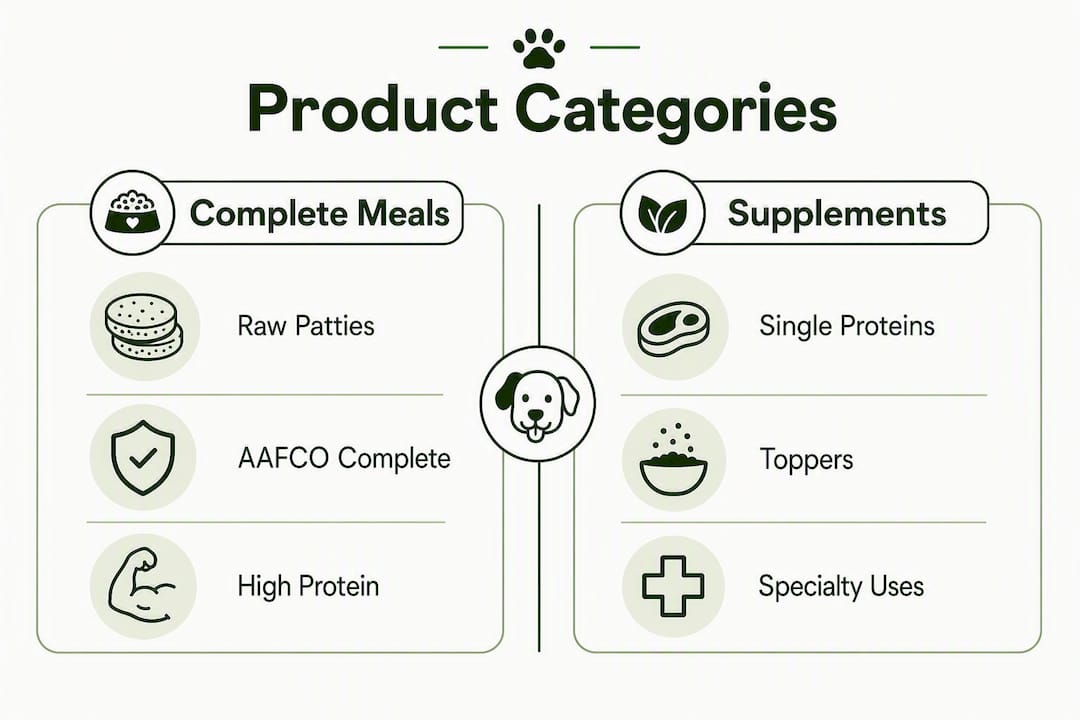
Complete meal patties are the workhorse of the category. Stella & Chewy’s Freeze-Dried Raw Dinner Patties, for example, list cage-free chicken as the first ingredient, include organ meat and bone, and carry an AAFCO complete-and-balanced statement for all life stages. Open Farm’s freeze-dried line emphasizes humanely raised proteins and transparent sourcing, which appeals to owners who want to know exactly where the meat came from.
Single-protein morsels from brands like Instinct (FreshDried line) and Steve’s Real Food work well for dogs with food sensitivities or owners building a rotation diet. Because the ingredient list is short, it’s easier to isolate a reaction if one occurs.
Toppers are where Fresh Is Best tends to shine. Their loose freeze-dried products are designed to be crumbled over existing meals, making them a low-risk, low-cost way to test whether your dog tolerates and enjoys freeze-dried food before you invest in a full-meal format.
Practical cost note: Subscription discounts of 10–15% are common across most brand sites. Buying a larger bag almost always lowers the per-serving cost, but only if you can use it within the recommended open-bag window (typically 4–6 weeks after opening).

How do you choose the right freeze-dried food for your dog?
Label checklist before you buy
- AAFCO statement: — Look for “complete and balanced” per AAFCO nutrient profiles or feeding-trial evidence. “Complementary” or “supplemental” means it cannot serve as a sole diet.
Questions to ask a retailer or manufacturer
- “Is this AAFCO-complete or intended as a topper?”
- “Do you use HPP or another validated pathogen-reduction step?”
- “Where is the protein sourced, and do you publish batch test results?”
- “Is this formulated for all life stages, or adults only?”
Feeding-use decision flow
- Decide the role: Full-meal replacement, rotation component, or topper. If you are unsure, start as a topper for 7 days and observe stool consistency and appetite.
- Check life-stage suitability: Puppies and large-breed puppies need formulas specifically validated for growth, not just “all life stages” claims without feeding-trial documentation.
- Transition gradually: Introduce over 7–14 days by replacing 25% of the current food every few days. Loose stools or appetite changes are signals to slow down.
- Portion by weight, not volume: Freeze-dried food is calorie-dense. Use the brand’s weight-based feeding chart as a starting point, then adjust for body condition.
Pro Tip: Ask any manufacturer for their feeding-trial documentation or batch analysis. A brand that can produce both is operating at a higher transparency standard than one that only cites AAFCO nutrient profiles. Petbite’s staff can help you ask the right questions before you commit to a bag.
What are the real pros and cons of freeze-dried dog food?
Pros
- Nutrient retention: Freeze-drying preserves enzymes and heat-sensitive micronutrients that high-heat processing destroys, making it nutritionally closer to raw than kibble.
- Palatability: Integrative veterinarians note freeze-dried raw can be a preferred option for picky dogs and those with sensitivities, largely because the flavor profile stays close to fresh meat.
- Convenience: No freezer required. Shelf-stable for months unopened, which matters for travel, emergencies, or owners without freezer space.
- Versatility: Works as a full meal, a topper, or a training treat. Freeze-dried formulas can be used across all three feeding roles, which gives owners flexibility as their dog’s needs change.
- Functional additions: Some lines include pre/probiotic blends to support gut health, which can be useful for dogs with digestive sensitivity.
Cons
- Cost: Freeze-dried diets are typically more expensive than kibble because the freeze-drying process itself is expensive. The per-ounce price is higher, though dogs often eat less by volume.
- Nutrient gaps: — Formulas without a complete vitamin/mineral profile or AAFCO feeding-trial backing may leave gaps over time, particularly in calcium/phosphorus balance.
Who should avoid it or proceed with caution
Safety callout: Veterinary sources advise caution for immunocompromised animals and households. Dogs undergoing chemotherapy, very young puppies, pregnant dogs, and households with immunocompromised people should consult a veterinarian before switching to any raw-style diet, including freeze-dried.
The risk is not theoretical. The FDA has documented Salmonella and Listeria contamination in raw and freeze-dried pet foods. Consult your vet before feeding freeze-dried to any dog in a medically vulnerable situation.
How do you feed, rehydrate, and store freeze-dried food safely?
Rehydration and serving
The standard starting point is approximately 2 tablespoons of water per 1 cup of freeze-dried food, but this is a guideline, not a rule. Some dogs prefer a wetter slurry; others like lightly moistened morsels. Adjust texture over the first week and monitor water intake, since a drier serving means your dog needs to drink more from the bowl.
| Serving style | Water ratio | Texture result | Best for |
|---|---|---|---|
| Slurry | 4–6 tbsp per 1 cup | Wet, soupy | Dogs transitioning from wet food |
| Standard rehydrated | 2 tbsp per 1 cup | Moist, crumbly | Most adult dogs |
| Lightly moistened | 1 tbsp per 1 cup | Slightly damp | Dogs who prefer texture |
| Dry (no water) | None | Crunchy | Training treats, toppers |

Portioning and calorie density
Because freeze-dried foods are calorie-dense, owners commonly overfeed when measuring by cup. Use the brand’s weight-based feeding chart as your baseline. A 40-pound adult dog eating a complete freeze-dried diet will typically eat far less by volume than the same dog eating kibble. Weigh portions on a kitchen scale until you have a reliable feel for the right amount.
Storage guidelines
- Unopened: Most freeze-dried products carry a shelf life of 1–2 years when stored in a cool, dry place away from direct sunlight.
- After opening: Reseal tightly after every use. Most manufacturers recommend using an open bag within 4–6 weeks. Oxygen and humidity are the main enemies.
- Temperature: Room temperature is fine for unopened bags. Avoid storing near a stove or in a humid pantry.
- Freezing: Some owners freeze opened portions in an airtight container to extend freshness, though this is not required.
Handling hygiene
Treat freeze-dried food with the same hygiene practices as raw meat: wash hands after handling, wash your dog’s bowl after every meal, and keep preparation surfaces clean. For more on raw diet handling safety, Petbite’s guide covers the key household precautions in detail.
What should you look for on the ingredient label?
Green flags
- Whole muscle meat as the first ingredient, named by species (chicken, beef, turkey, not “poultry” or “meat”)
- Organ inclusion (liver, kidney, heart) within the first five ingredients, or a declared supplemental calcium/phosphorus source
- Minimal fillers: A short ingredient list with no peas, lentils, or potato in the top three slots
- Clear sourcing statements: Country of origin for the primary protein, ideally with a farm or supplier name
- Added taurine in formulas relying heavily on plant proteins or legumes
- Vitamin/mineral premix or individually listed supplements to confirm nutritional completeness
Red flags
- High pea or legume content — without AAFCO feeding-trial justification, particularly for large breeds (the FDA has investigated a potential link between legume-heavy diets and dilated cardiomyopathy)
Reading the guaranteed analysis
The guaranteed analysis on a freeze-dried bag shows “as-fed” percentages, which are misleading for comparison because moisture content varies across formats. To compare protein and fat across kibble, wet food, and freeze-dried, convert to dry-matter basis: divide the as-fed percentage by (100 minus the moisture percentage), then multiply by 100. A freeze-dried food showing 40% protein as-fed with 5% moisture has a dry-matter protein of roughly 42%, while a wet food showing 10% protein with 78% moisture has a dry-matter protein of about 45%. The numbers tell a different story once moisture is removed from the equation.
What do vets say about pathogen risk in freeze-dried food?
Freeze-drying removes moisture but does not kill pathogens. That distinction matters practically. Freeze-drying is a dehydration process, not a sterilization process, and pathogens including Salmonella and Listeria can survive the process and remain viable in the finished product.
Some production lines add an HPP (high-pressure processing) step or batch-testing protocol to lower pathogen risk. HPP uses extreme water pressure to inactivate pathogens without heat, preserving nutrients while reducing microbial load. Not every brand uses it. Ask directly.
Safety callout: The FDA and veterinary sources consistently flag raw-style diets, including freeze-dried, as carrying higher pathogen risk than cooked commercial foods. Vets advise caution for immunocompromised animals and households, and standard precautions include treating the food like raw meat in the kitchen.
Safety checklist for purchase and home use
- Look for HPP or validated pathogen-control language on the packaging or brand website
- Ask for batch test results or a certificate of analysis before buying in bulk
- Check the brand’s recall history (the FDA’s recall database is searchable by brand)
- Wash hands after every handling contact
- Wash your dog’s bowl after every meal with hot water and soap
- Do not leave rehydrated food out for more than 30 minutes
- Monitor stool consistency and energy levels for the first two weeks on any new raw-style diet
For a broader look at safe raw feeding practices, Petbite’s guide covers household risk mitigation in detail.
This article provides general information, not veterinary advice. Consult a licensed veterinarian before making dietary changes, especially for dogs with medical conditions.
What does freeze-dried dog food actually cost, and where do you buy it?
Typical price ranges
Freeze-dried dog food costs more per ounce than kibble, and the gap is significant. The freeze-drying process is expensive, and that cost passes to the consumer. However, because freeze-dried food is calorie-dense, dogs eat less by volume, which narrows the per-serving gap somewhat.
- Complete meal patties: Typically $0.50–$1.50 per serving for a medium-sized dog, depending on brand and bag size
- Single-protein morsels: Similar range; smaller bags cost more per serving than larger formats
- Toppers: Lower per-use cost since you’re using a fraction of a bag per meal
- Boutique novel-protein formulas: Can run significantly higher per serving
Subscription discounts (typically 10–15% off) are available on most brand sites and on Chewy. Buying a larger bag lowers the per-ounce cost but only makes sense if you can use it within 4–6 weeks of opening.
Where to buy
- Brand websites: Stella & Chewy’s, Open Farm, Instinct, Steve’s Real Food, and Fresh Is Best all sell direct, often with subscription options
- Chewy and Amazon: Wide selection, competitive pricing, and subscription-and-save programs
- Specialty pet retailers: Better staff knowledge, ability to ask questions, and sometimes sample packs
- Petbite (Orléans): Local in-store and online purchasing with free same-day delivery within 3 km. Petbite stocks premium raw-style options and can help you find the right format before you commit to a full bag.
Practical buying tips
- Start with a smaller bag or a sample pack before buying in bulk, especially if your dog has not eaten raw-style food before
- Use a topper format first to test palatability and digestive tolerance at lower cost
- Factor in the cost of a kitchen scale if you plan to portion by weight (worth it for calorie-dense formats)
- Ask Petbite about current stock and local delivery windows if you want to avoid shipping wait times
Who should actually use freeze-dried food, and how do you start safely?
Freeze-dried dog food is the right call for health-conscious owners who want raw-style nutrition without the freezer management, and who are willing to follow safe handling practices consistently. It is not a set-it-and-forget-it food in the way kibble is.
Use-case tags:
- Full-meal replacement: Best for adult dogs in good health whose owners want to move away from kibble entirely. Requires an AAFCO-complete formula and a 7–14 day transition.
- Rotation diet component: Rotate proteins weekly or monthly to broaden nutrient diversity and reduce the risk of developing food sensitivities.
- Topper: Crumble over kibble or wet food to boost palatability and add raw-style nutrition without a full commitment.
- Training treats: Small morsels work well as high-value rewards. Calorie-dense, so factor them into daily totals.
When to consult a veterinarian first:
- Dogs with kidney disease, pancreatitis, or immune-mediated conditions
- Puppies under 12 weeks
- Pregnant or nursing dogs
- Households with immunocompromised people
- Any dog with a history of digestive issues or food allergies
What is freeze-dried dog food, and how does it differ from raw, frozen, and kibble?
Freeze-drying is a two-stage industrial process. First, raw ingredients are frozen solid. Then they go into a vacuum chamber where pressure drops low enough that ice converts directly to vapor without passing through liquid, a process called sublimation. The result is a product that has lost 98–99% of its moisture but retains its original structure, flavor, and most of its nutritional content.
That is what separates it from the other formats on the shelf. Kibble is cooked at high heat, which destroys heat-sensitive enzymes and some vitamins. Wet food is also heat-processed and contains high moisture, which limits shelf life once opened. Frozen raw preserves nutrition similarly to freeze-dried but requires a freezer and thawing time. Air-dried dog food uses low heat over a long period to remove moisture, which is gentler than kibble processing but less thorough than freeze-drying. The air-dried vs freeze-dried distinction matters: air-dried typically retains more moisture (around 10–15%) and has a shorter shelf life, while freeze-dried sits at 1–3% moisture and stays shelf-stable for up to two years unopened.
Freeze-dried is essentially frozen raw made pantry-friendly. The nutrition profile is close; the handling requirements are similar; the convenience gap is large.
How long does it take to go from bag to bowl?
This is one of the most practical questions owners ask, and the answer depends on how you serve it.
Dry (no rehydration): Open the bag, measure a portion, serve. About 30 seconds. This works for toppers and training treats.
Standard rehydration: Add approximately 2 tablespoons of water per 1 cup of freeze-dried food, stir, and let it sit for 2–3 minutes. Total time: under 5 minutes. Most owners do this at room temperature; warm water speeds absorption slightly.
Full slurry for picky eaters: Use 4–6 tablespoons of water, stir well, and let sit for 5 minutes. The result is a wet-food consistency that many dogs find more appealing than dry morsels.
Compare that to frozen raw: you need to thaw overnight in the refrigerator (8–12 hours) or use a cold-water thaw (30–60 minutes). Freeze-dried wins on prep time by a wide margin, which is a real practical advantage for busy households.
How does the long-term cost of freeze-dried compare to other diets?
Freeze-dried is the most expensive format per calorie, full stop. The freeze-drying process requires specialized industrial equipment, long processing cycles, and significant energy input. Those costs do not disappear at scale the way they do for kibble extrusion.
For a 40-pound adult dog eating a complete freeze-dried diet as the sole food, annual costs can run several times higher than a quality kibble. Wet food sits in between. Frozen raw is often cheaper per serving than freeze-dried, which is one reason owners who are fully committed to raw feeding often prefer frozen raw for daily meals and use freeze-dried for travel, emergencies, or as a topper.
The most cost-effective approach for most owners is a mixed strategy: a quality kibble or wet food as the base, with freeze-dried used as a topper or rotation component. This captures the palatability and nutrient benefits of freeze-dried without the full cost burden. For owners who want to compare frozen raw options alongside freeze-dried, Petbite’s raw food guide covers the full cost and nutrition comparison.
What is the environmental footprint of freeze-dried dog food production?
Freeze-drying is energy-intensive. The vacuum chambers, refrigeration systems, and long processing cycles consume substantially more electricity per pound of finished product than kibble extrusion or air-drying. That energy cost is the primary environmental concern.
On the other side of the ledger, freeze-dried food’s long shelf life reduces food waste significantly. Kibble and wet food spoil faster once opened; freeze-dried, properly sealed, can last weeks without degradation. Less waste per bag means fewer total bags purchased over a year, which partially offsets the production footprint.
Protein sourcing is the other major variable. Brands that use sustainably raised or humanely certified proteins (Open Farm publishes sourcing details by farm) have a meaningfully different environmental profile than those using commodity proteins from conventional supply chains. Novel-protein formulas using rabbit, venison, or insect protein tend to have lower land and water footprints than beef-heavy formulas, though they cost more.
The honest summary: freeze-dried is not the greenest pet food format, but it is not the worst either. If sustainability matters to you, prioritize brands with transparent sourcing and consider novel-protein formulas over beef-dominant ones.
Key Takeaways
Freeze-dried dog food delivers raw-style nutrition with shelf-stable convenience, but it requires AAFCO-complete labeling, safe handling like raw meat, and weight-based portioning to use correctly.
| Point | Details |
|---|---|
| AAFCO completeness is non-negotiable | Only use freeze-dried as a sole diet if the label carries an AAFCO “complete and balanced” statement. |
| Pathogen risk is real | Freeze-drying removes moisture but does not sterilize; treat it like raw meat and ask about HPP or batch testing. |
| Rehydration improves nutrition | Start at 2 tbsp water per 1 cup and adjust for texture; monitor water intake when serving dry. |
| Calorie density requires weight-based portioning | Measure by weight, not cup volume, to avoid overfeeding this calorie-dense format. |
| Petbite offers local access | Petbite in Orléans stocks premium raw-style options with free same-day delivery within 3 km for local owners. |
The case for starting slow and buying smart
The most common mistake owners make with freeze-dried food is going all-in on a large bag of a complete-meal formula before their dog has had a single bite of it. A dog that has eaten kibble its whole life may love freeze-dried immediately, or it may take two weeks of gradual introduction before the digestive system adjusts. Starting with a topper format, watching stool consistency for seven days, and only then scaling up is the approach that avoids wasted money and a stressed dog.
There is also a tendency to over-trust the “raw nutrition” framing and under-check the label. Not every freeze-dried product is AAFCO-complete. Some are explicitly supplemental, designed to be mixed with other foods. Feeding a supplemental product as a sole diet for months is a real nutritional risk, and it happens because owners assume “freeze-dried” automatically means “complete.” It does not. Read the AAFCO statement every time.
One more thing worth saying: the safety conversation around raw-style diets sometimes gets framed as a binary, either raw is dangerous or it is fine. The reality is more specific. The risk is concentrated in particular populations (immunocompromised dogs and people, very young puppies), and it is manageable with consistent hygiene. Most healthy adult dogs eating a properly formulated, HPP-treated freeze-dried diet from a reputable brand, handled with basic kitchen hygiene, are not in meaningful danger. The precautions exist for good reason, but they should not scare off owners who are willing to follow them.
Petbite carries premium raw-style food with same-day local delivery
If you are in Orléans and want to try freeze-dried or frozen raw food without waiting on a shipping estimate, Petbite is the local alternative to ordering from a national warehouse. The store stocks trusted Canadian brands across raw-style formats, including frozen raw options like Iron Will Raw Basic Rabbit and Iron Will Raw Basic Salmon, which pair well with freeze-dried toppers in a mixed feeding strategy.
Free same-day delivery within 3 km means you can order in the morning and have food in the bowl that evening. The staff can help you match a format to your dog’s life stage, health history, and budget before you commit to a full bag. Visit petbite.ca or stop in to ask about current stock, sample availability, and local delivery windows.
Further reading and authoritative sources
These are the core sources behind this article, plus recommended pages for owners who want to go deeper on specific questions.
-
AAFCO (Association of American Feed Control Officials): The definitive source for understanding what “complete and balanced” means on a pet food label, how feeding trials work, and what nutrient profiles are required by life stage. Start here if you want to understand label claims.
-
PetMD: Freeze-Dried Food for Dogs — Pros and Cons: Veterinarian-reviewed overview of safety concerns, handling precautions, and who should avoid raw-style diets. The most balanced clinical summary available online.
-
Dog Food Advisor: Best Freeze-Dried Dog Food: Independent reviews with dry-matter protein analysis and AAFCO life-stage notes across dozens of brands. Useful for comparing specific products by nutrient profile.
-
Forbes: Best Freeze-Dried Dog Food: Includes integrative veterinarian commentary on palatability, enzyme preservation, and use cases for picky eaters and sensitive dogs.
-
Petbite: Raw Dog Food Safety Guide: Petbite’s own guide to safe handling of raw-style diets, written for local owners. Covers kitchen hygiene, household risk, and what to watch for during a diet transition.
-
Petbite: Best Raw Dog Food Guide: Broader comparison of raw diet formats, including frozen raw vs freeze-dried, with local purchasing context.
-
NCBI: Research on raw pet food safety: Peer-reviewed research on pathogen prevalence in raw pet food diets. Relevant for owners who want the academic basis behind veterinary safety recommendations.
Consult a licensed veterinarian for individual dietary questions, especially for dogs with medical conditions, puppies, or households with immunocompromised members.