

The five main cat scratcher types are vertical posts, horizontal pads and loungers, ramps and wedges, wall-mounted scratchers, and multi-function towers. The fastest way to pick one: watch where your cat already scratches, then match the orientation and material to that behavior. If you’re unsure, start with a tall sisal vertical post plus a cardboard horizontal pad. That combination covers the two most common scratching styles and costs very little to test.
Quick behavior-to-scratcher map:
- Cat scratches the couch arm or door frame → vertical sisal post, at least 25 inches tall
- Cat scratches the rug or carpet → horizontal cardboard pad or flat lounger large enough to allow a full stretch
- Cat scratches low furniture legs → angled ramp or wedge scratcher
- Cat scratches walls or wants to climb → wall-mounted scratcher or cat tree with sisal posts
- Multi-cat household with territorial tension → multiple stations on different floors, mix of vertical and horizontal
When budget is tight, test with a cardboard pad first, then invest in a durable sisal post once you know what your cat actually uses.
Key Takeaways
The most effective approach to choosing a cat scratcher is to match orientation and material to your cat’s existing scratching behavior, then confirm fit with a size check before buying.
| Point | Details |
|---|---|
| Match orientation first | Observe whether your cat scratches vertical or horizontal surfaces before choosing a style. |
| Minimum size matters | Vertical scratchers should be at least 25 inches tall; horizontal ones at least 18 inches long. |
| Sisal outlasts cardboard | Sisal rope or fabric lasts 1–3 years; cardboard pads wear out in 2–8 weeks. |
| Placement drives use | Put scratchers where the cat already scratches, near resting spots, not in unused corners. |
| Petbite for local support | Petbite in Orléans stocks cat scratchers and accessories with free same-day delivery within 3 km. |
Table of Contents
- Why scratching is a biological need, not bad behavior
- The main cat scratcher types and how each one works
- Which materials actually hold up, and which ones your cat will prefer
- How to choose the right scratcher: a practical checklist
- How to get your cat to actually use a new scratcher
- When to clean, repair, or replace a scratcher
- Which scratcher type fits your cat’s profile
- Your practical shopping checklist before you buy
- Sources
Why scratching is a biological need, not bad behavior
Scratching is hardwired into every cat, regardless of breed, age, or indoor lifestyle. It serves four distinct functions: it stretches the spine and shoulder muscles, removes the dead outer layer of the claw, deposits scent from the paw glands to mark territory, and releases tension during stress or excitement.
Because scratching meets so many needs at once, a single scratcher tucked in a spare bedroom rarely gets used. The SF SPCA and most veterinary behaviorists recommend at least one scratcher per floor of the home, placed where the cat already spends time. That placement detail matters more than the price tag on the scratcher itself.
Claw health is worth singling out. When a cat drags its claws down a rough surface, the outer sheath peels away to reveal a sharper claw underneath. Without an appropriate outlet, cats use whatever surface gives them the right resistance, which is usually your sofa. Providing the right scratcher doesn’t just save your furniture; it keeps the cat’s claws in better condition between trims.
The main cat scratcher types and how each one works
Understanding the different types of cat scratchers is the foundation of any good buying decision. Each style suits a different scratching posture, space, and personality.
1. Vertical posts
The classic. A vertical post is a freestanding column wrapped in sisal rope, sisal fabric, or carpet, mounted on a weighted base. Cats use it by standing on their hind legs and pulling downward, which gives them the full-body stretch that mimics scratching a tree trunk.
Pros: Full-stretch engagement, widely available, suits most cats, durable when sisal-wrapped. Cons: Takes up floor space, must be tall enough (at least 25 inches) or cats won’t use it fully.
Placement: next to the couch or wherever the cat currently scratches vertical surfaces. Cats scratch to mark territory, so putting the post in a low-traffic hallway defeats the purpose.
2. Horizontal pads and loungers
A flat or slightly raised pad, usually made of corrugated cardboard, placed on the floor. Some are simple rectangles; others are shaped like a boat or a wave to double as a resting spot. Cardboard loungers work especially well for cats that like to scratch and then immediately lie down on the same surface, which is common in kittens and relaxed adult cats.
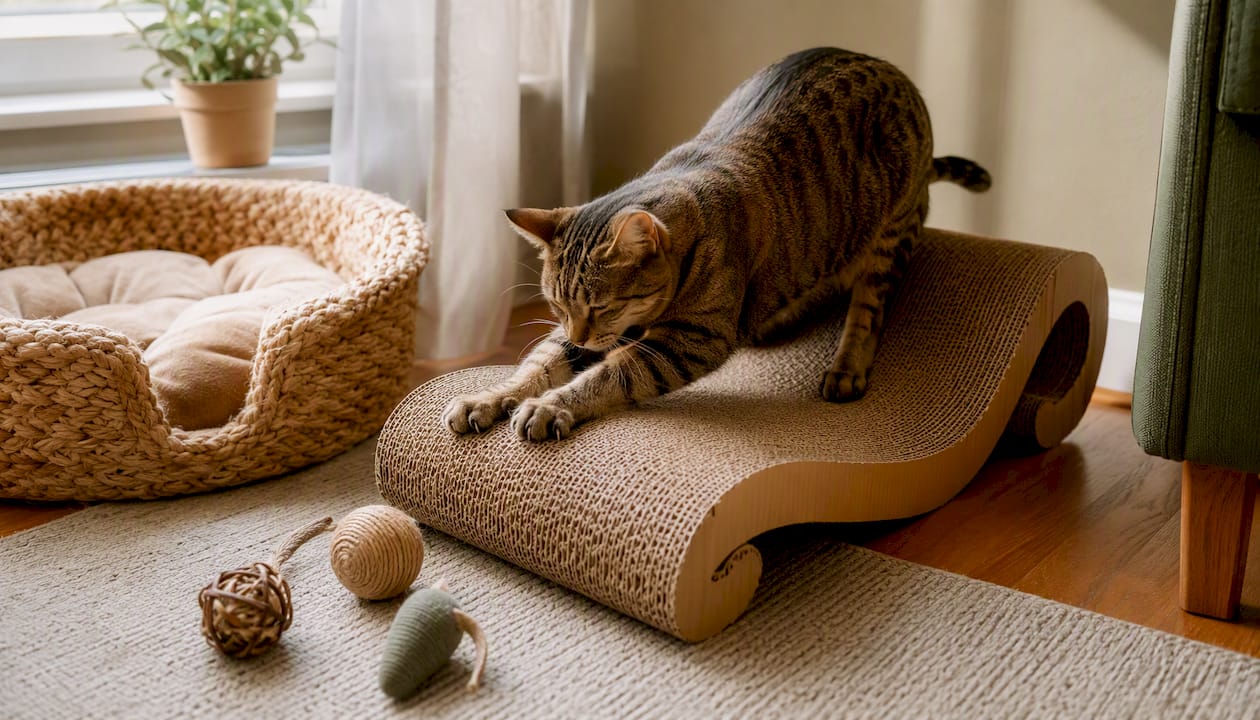
Pros: Inexpensive, low profile, doubles as a nap spot, easy to replace. Cons: Wears out fastest of all materials, cardboard shreds can scatter on the floor.
Placement: near a favorite sleeping area or in front of the couch. The Kong Naturals Scratcher is a good example of a multi-function lounger that works as both a scratcher and a resting pad.
3. Ramps and wedges
An angled scratcher, typically 30–45 degrees, that lets a cat scratch at a diagonal. This style suits cats that scratch low furniture legs or the base of a sofa because the angle replicates that posture. Many ramp scratchers are cardboard or sisal over a foam core.
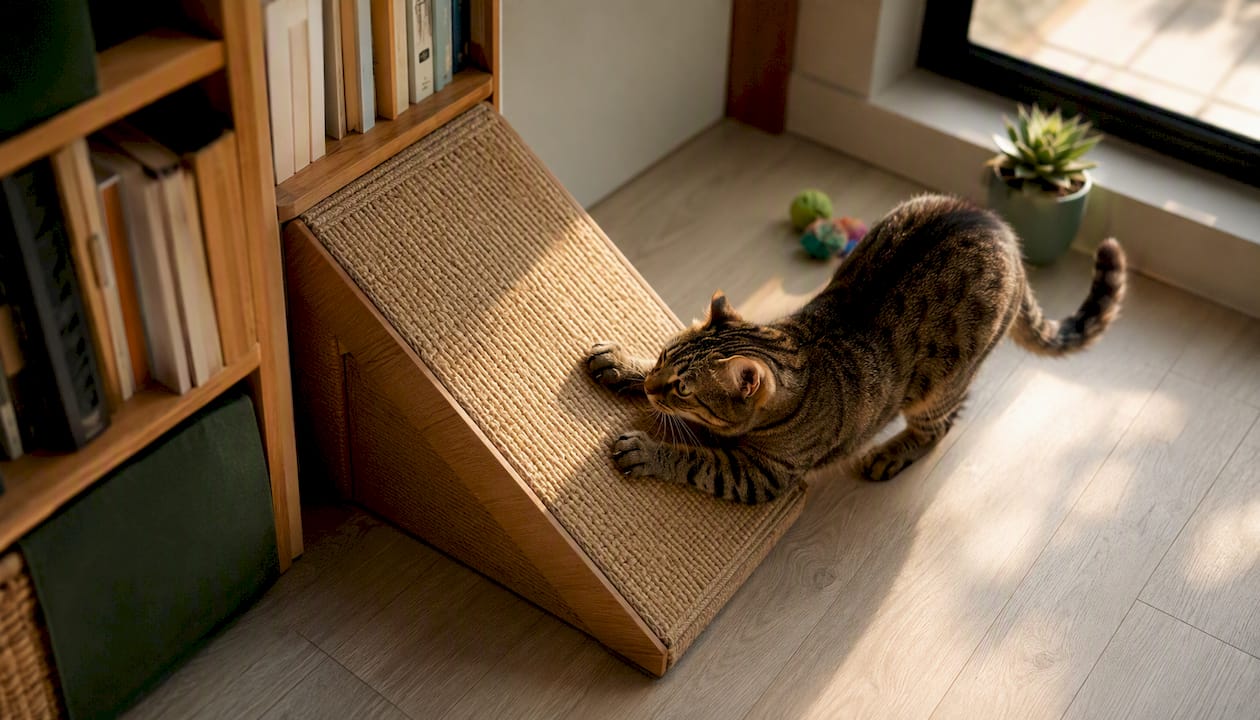
Pros: Space-efficient, works for cats that prefer a diagonal scratch angle, often lightweight. Cons: Less common, can slide on hardwood floors without a non-slip base.
For design-conscious owners, angled scratchers come in a range of materials and finishes that fit modern interiors without looking like a pet store display.
Placement: in front of or beside the piece of furniture the cat targets most.
4. Wall-mounted scratchers
A panel or post fixed directly to the wall, keeping the floor clear. Wall-mounted options are ideal for small apartments or for cats that like to scratch at standing height without the post tipping over. They require installation but are essentially impossible to knock down, which matters for larger or more aggressive scratchers.
Pros: Space-saving, extremely stable, can be positioned at the exact height the cat prefers. Cons: Requires drilling, not renter-friendly without damage-free mounting hardware.
For heavier cats, wall-mounted options with reinforced brackets provide the stability a floor post may lack.
Placement: near a window or beside a cat perch, at a height that allows full extension.
5. Multi-function towers and cat trees
A cat tree combines vertical scratching posts, platforms, hideaways, and sometimes hanging toys into one structure. The scratching surfaces are usually carpet or sisal-wrapped poles. These are the best option for multi-cat households because each cat can claim a different level.
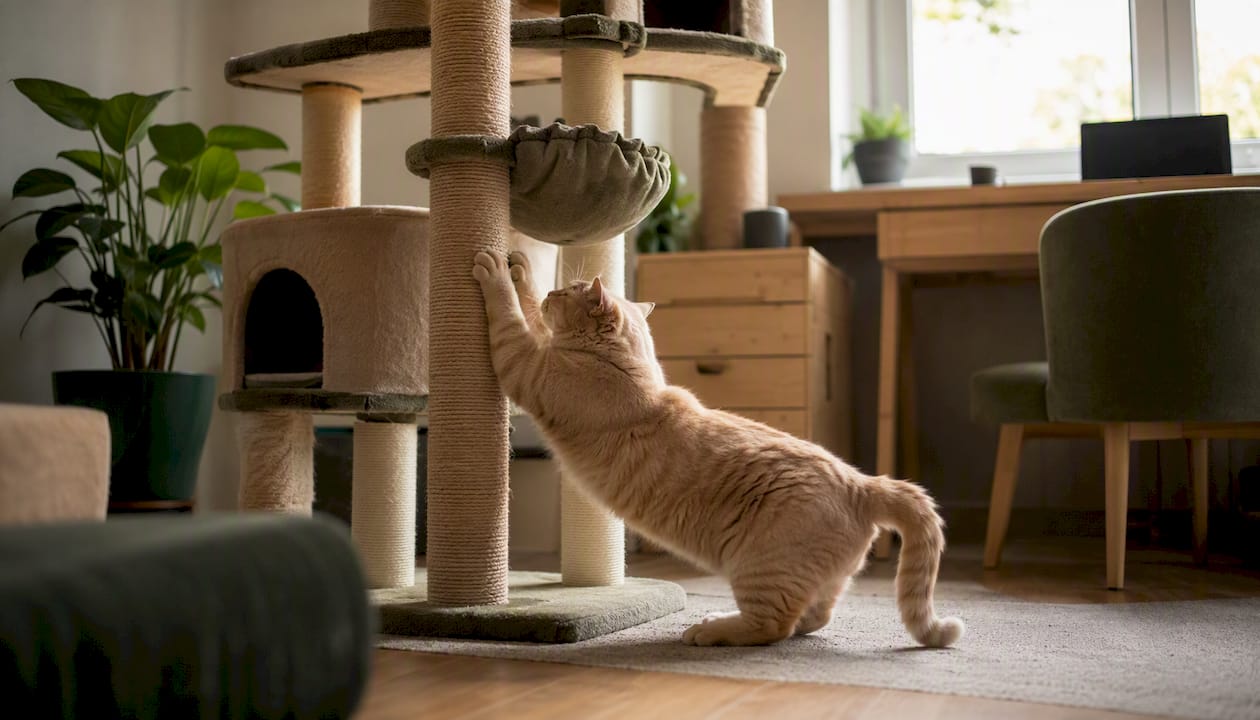
Pros: Enrichment, climbing, and scratching in one unit; reduces territorial conflict in multi-cat homes. Cons: Expensive, large footprint, carpet-covered versions wear faster than sisal.
Placement: near a window for environmental enrichment, in a main living area so cats actually use it.
6. Bowl and concave scratchers
A curved or bowl-shaped scratcher, usually cardboard, that cradles the cat while it scratches. The concave shape encourages cats to dig in from multiple angles and often doubles as a cozy resting spot. Less common than flat pads, but popular with cats that like to knead while they scratch.
Pros: Dual-use (scratcher and bed), encourages longer scratching sessions, compact. Cons: Cardboard fills up fast with shredded material, not suitable for aggressive shredders.
Placement: a quiet corner near a favorite resting spot.
7. DIY and repurposed options
A log section, a piece of sisal rope wrapped around a wooden post, or a carpet remnant stapled to a board can all work. DIY scratchers let you customize height, material, and angle to exactly what your cat prefers. The main risk is construction quality: loose staples, splinters, or unstable bases make any scratcher unsafe.
Pros: Fully customizable, low cost, can match exact cat preferences. Cons: Time-consuming, safety depends on build quality, no warranty or return option.
Pro Tip: If you go DIY, use natural sisal rope (not synthetic), avoid glue near the scratching surface, and test stability by pressing down firmly on the top before letting your cat use it unsupervised.
Which materials actually hold up, and which ones your cat will prefer
Material is where most buyers go wrong. A scratcher can be the right shape and the wrong surface, and a cat that ignores it isn’t being difficult — it just can’t get the grip it needs.
| Material | Traction | Durability | Mess | Best for |
|---|---|---|---|---|
| Sisal rope | High | High | Low | Most adult cats, aggressive scratchers |
| Sisal fabric | High | High | Very low | Cats that prefer a flat weave texture |
| Cardboard | Medium | Low | High (shreds) | Kittens, preference testing, loungers |
| Carpet | Medium | Medium | Low | Cats transitioning from carpet scratching |
| Jute/cotton rope | Medium | Medium | Low | Cats sensitive to rough sisal texture |
| Bare wood | Low | Very high | None | Cats that scratch tree bark outdoors |
Sisal-covered posts are typically preferred by cats and last longer than cardboard. Cardboard is cheap and popular but wears fastest, making it better as a supplement or a preference test than a long-term primary scratcher.
Matching material to cat behavior:
- Aggressive shredders (cats that destroy a cardboard pad in days) need sisal rope or sisal fabric for durability and real traction.
- Kittens do well on cardboard because it’s forgiving on young claws and easy to replace as they grow.
- Senior cats or cats with arthritis often prefer softer surfaces like carpet or jute rope, which require less force to engage.
- Cats that scratch carpet indoors tend to accept carpet-covered posts more readily, though sisal is still worth introducing over time.
Safety note: Check cardboard scratchers regularly for loose chunks. Most cats scratch and sniff without ingesting material, but chronic shredders who mouth the cardboard should be switched to sisal or jute. For any scratcher, avoid models with exposed staples, loose threads longer than an inch, or finishes that smell strongly of chemical solvents. Non-toxic, natural materials are the standard for quality scratchers.
Stability affects material preference too. Cats need a stable anchor to push off against when standing to scratch — a wobbly post discourages use even when the material is right. A wide, heavy base or wall anchoring solves this regardless of which surface you choose.
How to choose the right scratcher: a practical checklist
Stability and full-stretch height matter more than color, design, or price. A beautiful scratcher that wobbles or stands only 18 inches tall will be ignored by most adult cats within a week.
Step-by-step buying checklist:
- Measure your cat’s full-stretch height. Hold a treat above your cat’s head to encourage a full stand, then measure from the floor to the tip of the outstretched front paws. That measurement is your minimum post height. Testing programs recommend at least 25 inches for vertical scratchers and at least 18 inches for horizontal ones to allow a complete stretch.
- Check the base. A vertical post needs a base wide enough that it doesn’t tip when the cat pulls down hard. Press the top of any post in the store — if it rocks, pass on it.
- Pick material based on current behavior. If your cat scratches carpet, start with carpet or jute. If it scratches wood trim, try sisal. If you genuinely don’t know, observe what surface your cat already uses before spending on a premium post.
- Decide how many and where. One scratcher per floor is the baseline. Place at least one near the main sleeping area and one near the couch or the spot the cat currently scratches. Scratchers placed near resting spots and frequently used areas get used more than those tucked in corners.
- Set a budget and test first. Buy an inexpensive cardboard pad before committing to a $60 sisal post. If the cat uses the cardboard enthusiastically, you know the orientation works; then upgrade the material.
- Check for replaceable parts. Some sisal posts sell replacement rope or fabric panels. That extends the life of the base significantly and reduces long-term cost.
Pro Tip: To measure full-stretch height accurately, tape a piece of paper to the wall at your cat’s usual scratching spot and let it scratch. The highest claw mark is your minimum post height.
How to get your cat to actually use a new scratcher
Position and scent beat fancy design every time. A new scratcher placed in the right spot with the right scent cues will get used within days. The same scratcher moved to a spare bedroom may sit untouched for months.
Start with location. Place the new scratcher directly next to or in front of the surface the cat currently scratches. Don’t move it to a “better” spot until the cat is using it consistently. Cats scratch to mark territory, so the location has to feel relevant to them.
Days 1–2: Put the scratcher in place and let the cat investigate on its own. Rub a little catnip into the surface or sprinkle some on top. Don’t force interaction. A catnip toy placed on or near the scratcher can help draw the cat over without any pressure.
Days 3–4: When the cat approaches the scratcher, reward with a small treat or calm verbal praise. If the cat scratches even briefly, treat immediately. You’re building a positive association, not training a trick, so keep it low-key.
Days 5–7: If the cat is using the scratcher regularly, you can start very gradually moving it a few inches per day toward a more convenient spot, if needed. Move it too fast and the cat loses interest.
What to avoid:
- Never physically place the cat’s paws on the scratcher. This creates stress, not curiosity.
- Don’t move the scratcher to a corner or closet to keep it out of sight. Cats won’t seek it out.
- Avoid punishment when the cat scratches furniture. Redirect calmly to the scratcher and reward use.
- Pheromone sprays (like Feliway) applied near the scratcher can reduce territorial anxiety in cats that seem reluctant to engage with a new object.
For cats that need extra encouragement, pairing the scratcher with interactive play nearby gets them into the area and in an active, engaged state, which naturally leads to scratching.
When to clean, repair, or replace a scratcher
Inspect every scratcher once a week. The signs that a scratcher needs attention are easy to spot: loose threads longer than an inch, a base that rocks when pressed, cardboard so compressed it no longer shreds, or sisal rope that has unwound from the post. Replace when traction is lost or the structure becomes physically unsafe.
Estimated replacement timelines by material:
- Cardboard pads: 2–8 weeks depending on how aggressively the cat uses them
- Carpet-covered posts: 6–12 months with regular use
- Jute or cotton rope: 6–18 months
- Sisal rope or sisal fabric: 1–3 years with a single cat; shorter in multi-cat homes
These are ranges, not guarantees. An aggressive scratcher can destroy a sisal post in months; a light scratcher may use the same cardboard pad for three months.
Quick safety checklist before unsupervised access:
- No exposed staples or nails at claw height
- Base does not tip when you press the top firmly
- No loose threads or rope ends longer than one inch
- No strong chemical smell from finish or adhesive
- Cardboard is not so compressed that it has become a hard, slippery surface
- No visible mold or moisture damage (especially in humid rooms)
A worn scratcher isn’t always a problem. Cats often prefer a scratcher that already smells like them and shows some use. The issue is structural safety, not cosmetic wear. A frayed but stable sisal post is fine; a post that wobbles or has exposed hardware is not.
Which scratcher type fits your cat’s profile
Cats tend to prefer a scratcher that matches the surface they already use, so start by observing before buying. That said, a few common profiles make the decision straightforward.
- Kittens: Cardboard horizontal lounger to start. It’s soft on young claws, cheap to replace as they grow, and doubles as a nap spot. Add a small vertical post (around 20 inches) once they’re scratching confidently.
- Large or heavy cats: Tall, heavy-base sisal post (at least 30 inches) or a wall-mounted scratcher. A lightweight post will tip, and a tipping post gets abandoned fast. For more on sizing and weight capacity, cat furniture for large cats covers the key specs to look for.
- Multi-cat households: Multiple stations on different floors, at least one vertical and one horizontal per cat. Multi-cat homes benefit from variety and spread-out placement to reduce competition and territorial conflict. A cat tree with multiple sisal posts handles this well.
- Apartment or space-limited homes: Wall-mounted scratcher or a compact angled ramp. Both take up minimal floor space and can be positioned at the exact height the cat prefers.
- Senior or arthritic cats: Low-profile horizontal pad or a gently angled ramp. Reaching up to a tall post can be uncomfortable for cats with joint issues. Softer materials like carpet or jute are easier on aging claws.
- Indoor-only cats: These cats often scratch more intensely because they have no outdoor outlets. A tall sisal post plus a cardboard lounger covers both orientations and gives them a meaningful physical outlet.
For most households with one or two adult cats, the practical starting point is a tall sisal vertical post and a cardboard horizontal pad. That covers both orientations, costs under $40 combined, and tells you quickly which style the cat prefers.
Your practical shopping checklist before you buy
Before you order or walk into a store, run through this short checklist. It takes two minutes and prevents the most common buying mistakes.
- Measure your cat’s full-stretch height at home. Use the wall-paper method from the measuring tip above, or simply hold a treat high and note where the paws reach. Write the number down before you shop.
- Note the current scratch surface. Vertical fabric or wood? Horizontal carpet or rug? That tells you orientation and material in one observation.
- Check the base-to-height ratio in store. The base should be at least one-third the height of the post. Anything narrower tips under real use.
- Scratch the surface with your fingernail. If it gives you good resistance and doesn’t feel slippery, the cat will likely feel the same. Sisal should feel coarse and grippy; cardboard should shred slightly under pressure.
- Ask about replaceable parts. A post with a replaceable sisal wrap costs more upfront but lasts years longer than a sealed unit.
- Check the return policy. Some cats reject a scratcher on smell alone. A 30-day return window lets you test without risk.
Pro Tip: Test stability in the store by pressing the top of the post firmly downward and sideways. If it rocks more than half an inch, the base is too small for a confident scratcher.
If you’re in the Orléans area, Petbite carries a curated selection of cat scratchers and accessories with free same-day delivery within 3 km. Skip the guesswork on sizing and material by stopping in or reaching out for a recommendation based on your specific cat.
What Petbite actually stocks and why we recommend what we do
At Petbite, the focus is on practical, cat-tested products rather than the widest possible catalog. The scratchers and accessories stocked here are chosen because they hold up to real use, use non-toxic materials, and represent genuine value for cat owners in the Orléans area. This guide reflects that same standard: every recommendation is grounded in veterinary and shelter guidance, not marketing copy.
This guide covers the most common scratcher types and materials available in the U.S. and Canadian market. It doesn’t cover every niche product on the market, and it doesn’t make claims about specific performance data Petbite hasn’t verified directly. What it does reflect is the practical experience of helping local cat owners find what actually works for their cats.
Petbite has what your cat needs, delivered the same day
Choosing the right scratcher is easier when you don’t have to sort through hundreds of options alone. Petbite stocks quality cat scratchers, catnip toys, and grooming tools at our Orléans location, with free same-day delivery within 3 km so you can test a new scratcher today without leaving the house.

A good starting point for most cats: a sisal vertical post paired with a cardboard lounger. Both are available through Petbite, along with PetKind salmon treats to use as rewards during scratcher training. Already know what your cat needs? Browse the full selection at Petbite or book a grooming session with our certified groomers, who’ve cared for over 500 animals with a 5-star average rating.
Sources
- 15 Best Scratching Posts for 2026—We Tested Them All
- The Best Cat Scratchers for 2026 | Reviews by Wirecutter
- What’s Your Cat’s Scratching Style? | PetMD
- 5 Types of Cat Scratchers: Pictures, Info & Key Differences (Vet-Verified)