

The most effective daily mix is short training sessions (5–10 minutes), a scent game, one meal served through a puzzle or stuffable toy, and a supervised chew. That combination covers cognitive, sensory, and independent enrichment without adding an hour to your day. Here are ready-to-run ideas you can start right now:
- Quick sniff game (1–3 min, easy): hide a few kibble pieces under three cups, let your dog find them.
- 5-minute trick session (5 min, easy/medium): pick one known cue and one new one; reward with small training treats instead of a full meal portion.
- Frozen stuffable toy (10–40 min, easy): pack a KONG-style toy with your dog’s regular food mixed with a spoonful of wet food, freeze overnight.
- Puzzle feeder (10–20 min, medium): pour the morning meal into a multi-slot puzzle toy instead of a bowl.
- Scatter feeding (5 min, easy): toss kibble across a snuffle mat or into the grass; your dog works for every bite.
- Supervised chew (15+ min, easy): a size-appropriate durable chew occupies a dog independently and satisfies the urge to gnaw.
- DIY muffin-tin puzzle (5–10 min, easy): drop treats into a muffin tin, cover each cup with a tennis ball.
- Hide-and-seek (5–10 min, medium): ask your dog to sit-stay, hide in another room, then call them.
Pro Tip: Rotate these activities daily and use a portion of your dog’s regular meal as the reward to avoid calorie creep. If your dog eats 2 cups of kibble a day, subtract whatever goes into puzzles and training from that total.
Key Takeaways
The most effective approach to dog mental enrichment is combining short training sessions, scent work, meal-based puzzles, and independent chews across the week, rotating types to maintain novelty and prevent boredom.
| Point | Details |
|---|---|
| Swap one meal into a puzzle daily | Use a puzzle feeder or stuffable toy for one meal; subtract that portion from the daily ration to keep calories stable. |
| Add two 5-minute training sessions | Short, frequent sessions (5–10 minutes) build focus and mental fatigue more effectively than one long session. |
| Rotate toys every 3–5 days | Storing toys out of sight and cycling them back preserves novelty and long-term engagement. |
| Match activity to motivation type | Food-driven dogs thrive on puzzle feeders; toy-driven dogs respond better to tug and fetch games with rules. |
| Petbite for local enrichment supplies | Petbite stocks puzzle toys, durable chews, and premium food fillings with free same-day delivery within 3 km of Orléans. |
Table of Contents
- Why does mental enrichment matter for your dog’s wellbeing?
- What are the five types of enrichment, and how do you mix them?
- How to turn every meal into enrichment with puzzles, KONGs, and scatter feeding
- How to start scent games and beginner nose work at home
- Interactive games and short training sessions that boost cognition
- How to choose independent enrichment toys your dog will actually use
- Easy DIY enrichment projects using household items
- Non-food enrichment for dogs who aren’t food-motivated
- Safety rules, supervision, and rotating toys to keep enrichment effective
- How to build a simple 7-day enrichment plan for your dog
- Why starting small beats the perfect enrichment plan
- Where Petbite makes enrichment easier to start
- Sources
Why does mental enrichment matter for your dog’s wellbeing?
Mental enrichment is not optional. According to the American Animal Hospital Association, enrichment is a welfare necessity that lets dogs express innate behaviors: sniffing, foraging, and problem-solving. When those outlets are missing, dogs find their own outlets, usually destructive chewing, excessive barking, or hyperactivity that looks like a “bad dog” problem but is really a bored dog problem.
The behavioral payoff is real and measurable. Dogs who get regular mental stimulation tend to chew less destructively, settle more calmly at home, and respond better during training because their brains are practiced at focusing. Think of it like this: a dog who has already worked hard for breakfast is far less likely to shred your couch cushions by noon.
Veterinary and humane society guidance consistently frames enrichment not as a bonus activity but as a daily need on par with exercise and nutrition. The good news: most effective enrichment takes under 15 minutes and costs nothing beyond what you already have at home.
What are the five types of enrichment, and how do you mix them?
The AAHA framework identifies five enrichment categories. Knowing them helps you avoid repeating the same stimulus every day, which is the fastest way to kill your dog’s interest.
- Cognitive: problem-solving tasks like puzzle feeders, shell games, and trick training.
- Sensory: activities that engage smell, sight, or touch, including nose work, snuffle mats, and new textures.
- Physical: movement-based work like structured fetch, indoor agility, or tug-with-rules.
- Social: interaction with people or other dogs, including training sessions and cooperative play.
- Environmental: changing the surroundings, such as a new walking route, a window perch, or a novel object to investigate.
Aim to hit at least two or three different types on any given day. A morning puzzle feeder (cognitive) plus a 5-minute training session (social/cognitive) plus a supervised chew in the afternoon (sensory/physical) covers the bases without requiring a structured “enrichment hour.”
| Type | Purpose | Typical Duration | Best Fit |
|---|---|---|---|
| Cognitive | Problem-solving, focus | 10–20 min | All ages; great for high-drive dogs |
| Sensory | Calming, nose engagement | 5–20 min | Anxious dogs, seniors, low-energy dogs |
| Physical | Energy release, coordination | 10–30 min | Young, high-energy dogs |
| Social | Bonding, impulse control | 5–15 min | Dogs with strong handler focus |
| Environmental | Novelty, curiosity | Ongoing | Dogs prone to boredom or repetitive behaviors |
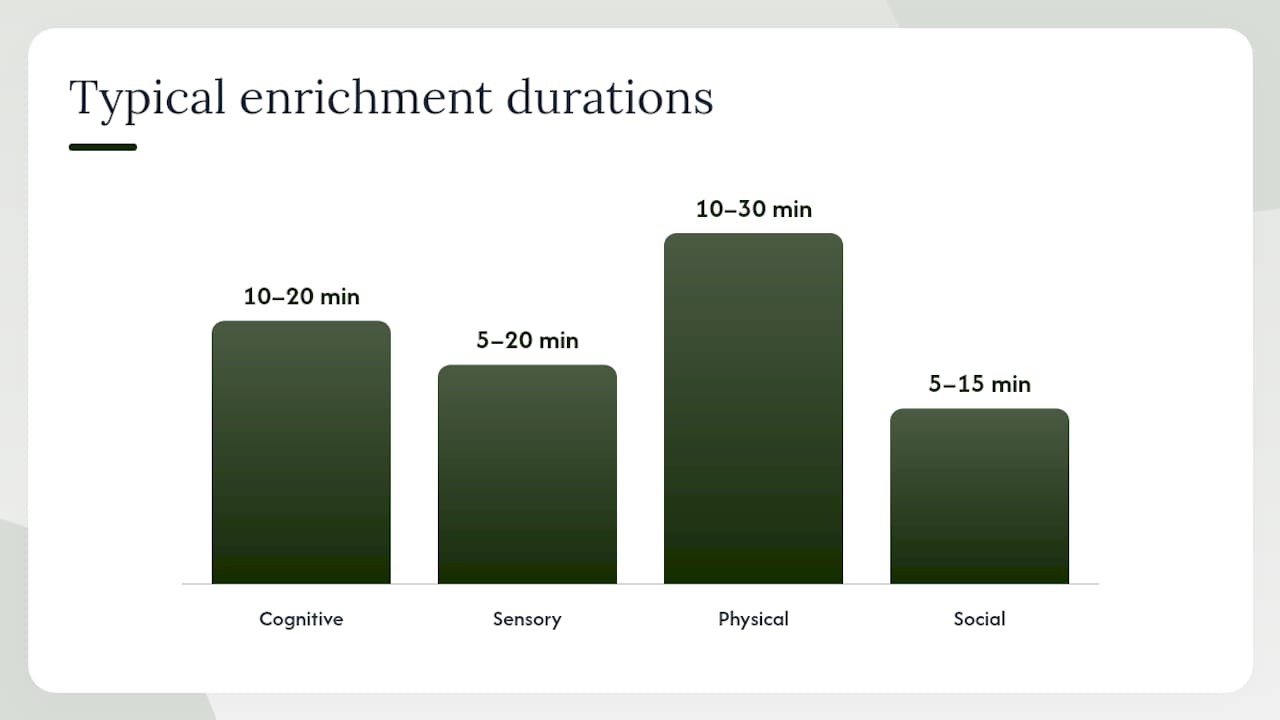
Match the activity to what motivates your dog. Food-driven dogs thrive on puzzle feeders and scatter feeding. Toy-driven dogs prefer fetch variations and tug. Social dogs get the most from training sessions and hide-and-seek. Animal Wellness Magazine notes that adapting by breed and motivation style makes enrichment stick as a habit rather than a chore.
How to turn every meal into enrichment with puzzles, KONGs, and scatter feeding
Mealtime is the easiest daily enrichment opportunity you have, and you are already doing it twice a day. Shifting from a bowl to a puzzle or stuffable toy requires no extra time once you have the setup down.
KONG-style stuffing, step by step
- Choose a size-appropriate stuffable rubber toy (the toy should be too large to swallow whole).
- Plug the small hole with a dab of peanut butter (xylitol-free) or wet food.
- Fill with your dog’s regular kibble mixed with a spoonful of premium wet food or mashed banana.
- Freeze for at least two hours. A frozen stuffed toy takes 20–40 minutes to empty versus 2 minutes for a bowl.
- Reduce the bowl portion by the amount you stuffed into the toy. Daily calories stay the same.
Puzzle feeders
Pour the meal into a multi-slot puzzle feeder instead of a bowl. Start with the easiest level (sliding covers, simple lifts) and move up only when your dog solves it in under five minutes. The ASPCA’s DIY enrichment guidance confirms that progressive difficulty keeps the activity genuinely challenging rather than just slow.
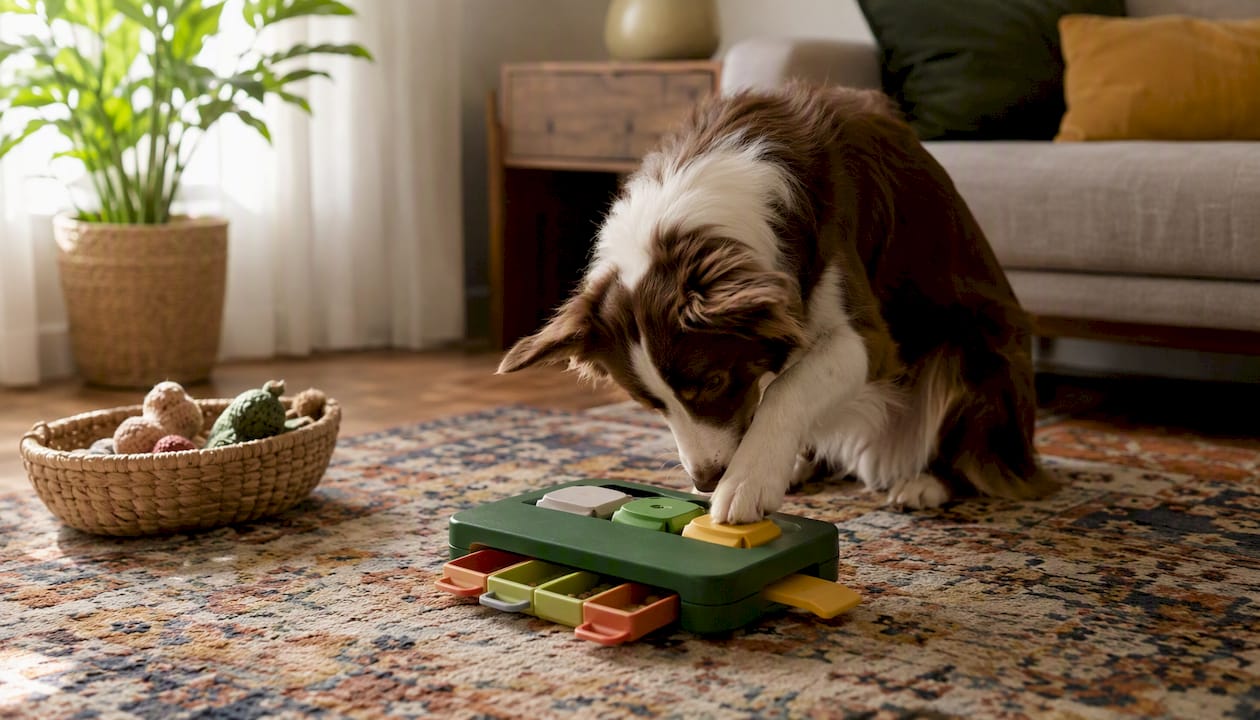
Scatter feeding and snuffle mats
Toss kibble across a snuffle mat or into the backyard grass. Your dog uses their nose to locate every piece, which is cognitively tiring in a way that a bowl never is. A snuffle mat session typically takes 5–15 minutes for a meal that would take 30 seconds from a bowl.
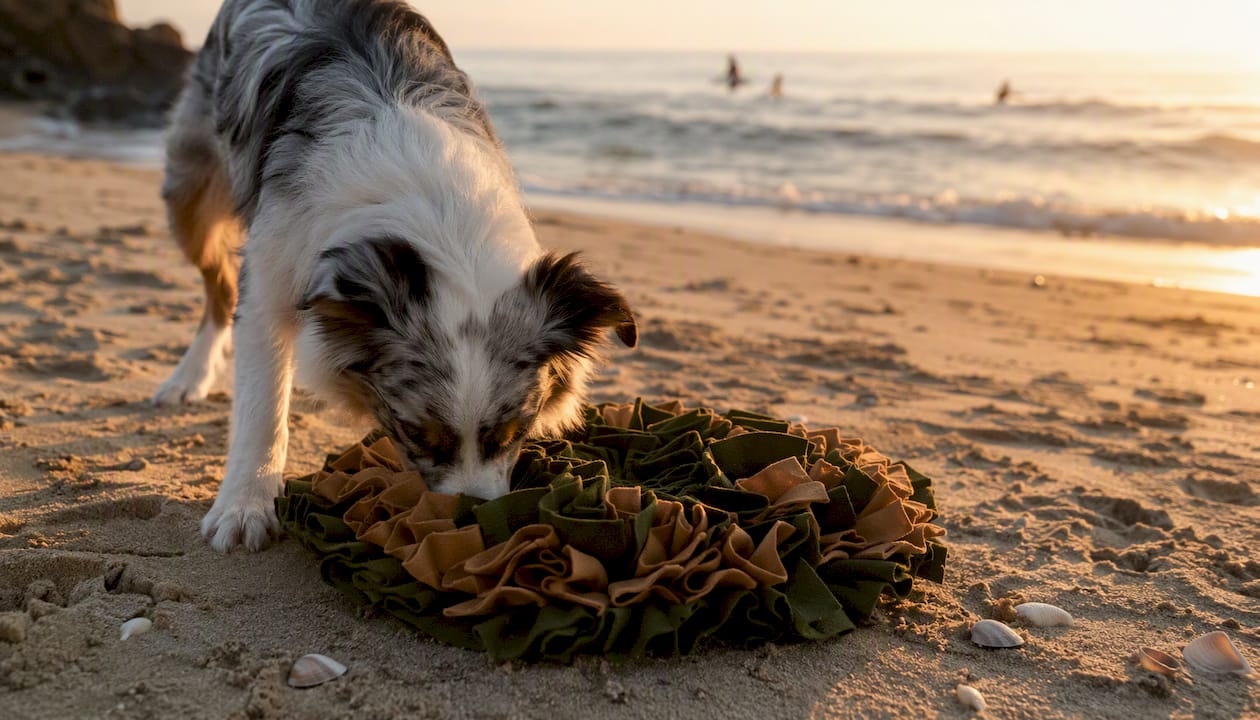
DIY muffin-tin feeder
Drop a few pieces of kibble or a small treat into each cup of a standard muffin tin, then cover each cup with a tennis ball. Your dog has to remove each ball to reach the food. Easy version: leave two or three cups uncovered so they learn the game. Hard version: cover all 12.
Pro Tip: Always subtract puzzle-used food from the daily ration. A rough formula: if your dog’s daily allowance is 300 grams of kibble, and you use 100 grams in a morning puzzle and 50 grams in a training session, the evening bowl gets 150 grams. Simple math, no weight gain.
Safety notes: use only size-appropriate toys, avoid xylitol, grapes, raisins, macadamia nuts, and onion in any stuffing, and supervise the first few sessions with any new toy until you know how your dog interacts with it.
How to start scent games and beginner nose work at home
Scent work is the single most mentally tiring activity for most dogs, and it requires almost no equipment. A dog’s nose contains roughly 300 million olfactory receptors compared to about 6 million in humans, which means sniffing is genuinely hard cognitive work for them. Research also suggests that extended sniffing lowers a dog’s pulse rate, making nose work one of the few activities that is both stimulating and calming at the same time.
Here is a simple progression from beginner to intermediate:
- Level 1 — Toss and find (easy): toss a treat a few feet away and say “find it.” Once your dog gets the idea, toss it into longer grass or behind a chair.
- Level 2 — Muffin tin or snuffle mat (easy/medium): as described above; the dog must use their nose to locate hidden food under covers or in fabric folds.
- Level 3 — Room hide-and-seek (medium): while your dog waits in another room, hide 5–10 small treats around one room. Release them with “find it” and let them search.
- Level 4 — House-wide search (medium/hard): expand the search area to multiple rooms. Increase the number of hides and use higher-value treats to maintain motivation.
- Level 5 — Outdoor scent trails (hard): drag a treat or scented cloth along a path in the yard, then let your dog follow the trail to a jackpot reward at the end.
Statistic callout: Dogs have approximately 300 million olfactory receptors, compared to roughly 6 million in humans. That gap means a 10-minute sniff session is genuinely tiring in a way that a 10-minute walk often is not.
Progression tip: your dog is ready to move up a level when they solve the current one in under two minutes with no hesitation. If they give up or look to you for help, the difficulty jumped too fast.
Pro Tip: For formal nose work, look for AKC Scent Work classes or a certified nose-work instructor in your area. The AAHA indoor enrichment guide recommends structured scent progressions as one of the most effective indoor activities for dogs of all ages.
Interactive games and short training sessions that boost cognition
Short, frequent training sessions provide some of the highest-value mental work available to a dog. The MSPCA-Angell recommends keeping sessions to 5–10 minutes, and that ceiling exists for a good reason: dogs learn faster in short bursts, and owners are more consistent when sessions don’t feel like a commitment.
Games worth adding to your rotation
Shell game: place three cups upside down, hide a treat under one while your dog watches, shuffle slowly, and ask them to choose. This builds focus and impulse control simultaneously.
Structured fetch with cues: instead of just throwing, ask for a “sit” before each throw, a “drop it” on return, and a “wait” before releasing. Fetch becomes a training session in disguise.
Tug-with-rules: tug is excellent physical and mental exercise when you set the rules. Your dog must “take it” and “drop it” on cue. The game stops immediately if teeth touch skin. Dogs who learn tug rules actually show better impulse control across the board.
Impulse-control games: “it’s yer choice” (hold a treat in a closed fist; reward only when the dog backs off and makes eye contact) and “leave it” progressions are short, repeatable, and genuinely tiring.
A 5–10 minute training session template
- Warm-up (1 min): ask for two or three known cues your dog nails every time. This gets them engaged and confident.
- New skill work (3–4 min): introduce or practice one new behavior in 5–10 repetition sets.
- Reward pattern (1 min): end on a success. Ask for the easiest cue in your dog’s repertoire and reward generously.
- Cooldown (1 min): a brief sniff break or calm petting signals the session is over.
For dogs not motivated by food, swap kibble for a short tug session or a favorite toy as the reward. The MSPCA notes that if a dog ignores regular kibble during training, upgrading to a higher-value reward (small pieces of cooked chicken, for example) often resolves the issue before assuming the dog is unmotivated.
Stop the session when you see yawning, sniffing the ground, or repeated failures on a cue the dog knows well. Those are frustration signals, not stubbornness.
How to choose independent enrichment toys your dog will actually use
Independent enrichment covers everything your dog can do without you actively running the game: puzzle toys, long-lasting chews, and exploration setups like snuffle boxes or ball pits. The goal is safe, sustained engagement that gives you a break while giving your dog a job.
Product categories and use cases
Stuffable rubber toys (KONG-style): the gold standard for independent enrichment. Freeze them for longer engagement. Size up if your dog empties one in under five minutes.
Multi-step puzzle toys (Nina Ottosson-style): sliding covers, spinning layers, and lift-and-reveal mechanisms teach dogs to work through a sequence. Start at Level 1 and move up only when the current level is solved quickly and confidently. The SPOT Grill Time puzzle is a good entry-level option.
Durable chews (Nylabone-style): long-lasting chews satisfy the gnawing drive and keep dogs occupied for 15 minutes to over an hour depending on the chew and the dog. The Kong Squeezz Dental Bone combines chewing with dental benefit.
Ball pits and snuffle boxes: fill a shallow bin with tennis balls and hide treats or a favorite toy inside. Your dog digs, sniffs, and problem-solves to find the reward.
Snuffle mats: fabric foraging mats that mimic searching through grass. Excellent for seniors and dogs recovering from injury who need low-impact mental work.
Safety checklist before leaving a dog with any toy
- The toy is too large to be swallowed whole.
- No small removable parts that could be chewed off and ingested.
- No toxic materials (check for BPA-free rubber, food-safe dyes).
- Inspect after every session; discard when pieces start breaking off.
- Supervise the first two or three sessions with any new toy before leaving the dog alone with it.
- Clean stuffable toys after each use to prevent mold.
Toy rotation keeps novelty alive
AAHA recommends rotating enrichment items every few days rather than leaving everything out permanently. A simple approach: keep three or four toys in rotation, swap one out every three to five days, and store the rest out of sight. The toy that was ignored last week becomes exciting again after a few days away.
Easy DIY enrichment projects using household items
Cheap, safe DIY projects can match store-bought enrichment when they are built for safety and progressive challenge. The ASPCA and Dogster both document household-based puzzles as genuinely effective, not just budget substitutes.
Six projects you can build today
-
Muffin-tin puzzle Materials: standard muffin tin, 12 tennis balls, kibble or small treats. Steps: (1) Place a few pieces of kibble in each cup. (2) Cover each cup with a tennis ball. (3) Set the tin on the floor and let your dog investigate. (4) Reward enthusiastically when they remove a ball and find the treat. Difficulty up: cover all cups. Difficulty down: leave half uncovered.
-
Bottle dispenser Materials: clean plastic water bottle (label removed), kibble. Steps: (1) Poke 4–6 holes slightly larger than a kibble piece in the bottle sides. (2) Fill one-third with kibble. (3) Replace the cap. (4) Show your dog the bottle and let them bat it around to dispense food. Safety: supervise closely; discard if the dog begins chewing the plastic rather than rolling it.
-
Cardboard box foraging Materials: a cardboard box, crumpled newspaper or paper bags, treats. Steps: (1) Crumple several sheets of newspaper. (2) Hide treats among the crumpled paper inside the box. (3) Let your dog dig and sniff. Difficulty up: add more layers of paper. Safety: remove any tape or staples before use.
-
Towel roll puzzle Materials: a hand towel, treats. Steps: (1) Lay the towel flat. (2) Place treats at intervals along the towel. (3) Roll the towel loosely. (4) Let your dog unroll it to find the treats. Easy version: roll loosely. Hard version: tie a loose knot in the middle.
-
Egg carton puzzle Materials: clean cardboard egg carton, small treats. Steps: (1) Place a treat in each cup. (2) Close the lid. (3) Let your dog figure out how to open it. Supervise to prevent ingestion of cardboard pieces.
-
Ice block treasure hunt Materials: a container, water, kibble or dog-safe fruit pieces. Steps: (1) Fill the container with water. (2) Drop in kibble or small pieces of apple or blueberry. (3) Freeze solid. (4) Pop out the block and give it to your dog outdoors or on a towel. Great for hot days; provides sensory and foraging enrichment simultaneously.
General safety rules for all DIY projects: avoid small parts that could be swallowed, skip toxic materials (no rubber bands, no staples, no plastic bags), and always supervise the first session to see how your dog interacts with the item before leaving them alone with it.
Non-food enrichment for dogs who aren’t food-motivated
Not every dog will work for kibble, and some dogs have dietary restrictions that make food-heavy enrichment impractical. Non-food enrichment works just as well for many dogs, and for some it works better.
- Tug-with-rules: as described in the training section, tug is a high-value game for toy-driven dogs. The mental work comes from the impulse-control rules, not the food.
- Chase and retrieve sequences: use a flirt pole or a favorite toy on a rope. The dog chases, catches, and brings back. Add a “drop it” cue to build the cognitive layer.
- Puzzle toys with nonedible rewards: fill a multi-step puzzle with a small plush toy or a squeaky ball instead of food. Some dogs are more motivated to “find” a toy than a treat.
- Supervised ball pit with toys: hide a favorite squeaky toy among tennis balls in a shallow bin. The dog digs and sniffs to locate it.
- Window-watching perch: a stable perch near a window with outdoor activity (bird feeder, street view) provides environmental enrichment with zero effort on your part. The Cat and Dog House notes that observation spots are among the easiest low-effort enrichment setups for busy owners.
- Calm grooming as sensory enrichment: a slow, gentle brushing session with a soft grooming tool like the Kong ZoomGroom provides tactile stimulation and bonding. For many dogs, especially seniors, this is genuinely relaxing and mentally engaging.
- Scent-free tracking games: drag a favorite toy along a path in the yard and let your dog follow the visual and scent trail to find it at the end.
For seniors, overweight dogs, or dogs recovering from surgery, low-impact options like window watching, gentle grooming, and slow sniff walks on a long line are the right fit. Adapt the intensity, not the concept. Measuring engagement without food is straightforward: watch for sustained focus, a relaxed but alert posture, and voluntary return to the activity after a break.
Safety rules, supervision, and rotating toys to keep enrichment effective
Supervise new items, inspect regularly, and rotate frequently. Those three rules cover most enrichment safety problems before they happen.
Safety checklist
- Size fit: any toy or chew should be too large to fit entirely in the dog’s mouth. When in doubt, size up.
- Removable parts: check for eyes, buttons, squeakers, or plastic pieces that could be chewed off. Remove or avoid them.
- Toxic materials: avoid fillings with xylitol, grapes, raisins, onions, macadamia nuts, or chocolate. Use xylitol-free peanut butter.
- Chew wear: inspect chews and rubber toys after every session. Discard when pieces start breaking off or the toy is worn down to a size that could be swallowed.
- Cleaning: wash stuffable toys after each use. Mold in a KONG-style toy is a real hazard that is easy to miss.
- First sessions: always supervise the first two or three sessions with any new toy before leaving the dog alone with it.
Calorie adjustment example
If your dog’s daily ration is 300 grams of kibble: a morning puzzle feeder uses 80 grams, a training session uses 40 grams, and the evening bowl gets 180 grams. Total stays at 300 grams. No extra calories, no weight gain.
Session-length guidance
The MSPCA notes that most dogs benefit from 30–45 minutes of physical exercise daily, and mental exercise follows similar principles. Practical session lengths:
- Scent work: 5–20 minutes depending on difficulty and the dog’s experience level.
- Puzzle feeder: 10–40 minutes depending on the complexity of the puzzle and whether the filling is frozen.
- Training session: 5–10 minutes, two to three times per day.
Stop any session when the dog disengages, shows frustration (repeated failures, pawing at you, walking away), or falls asleep mid-activity. These are signals the session was long enough, not that the dog is uninterested.
How to build a simple 7-day enrichment plan for your dog
One short daily anchor activity plus two or three varied sessions per week from different enrichment types is enough to see a real difference in your dog’s behavior within two weeks.
7-day sample schedule
| Day | Morning | Afternoon/Evening |
|---|---|---|
| Monday | Puzzle feeder (cognitive, 15 min) | 5-min training session (social) |
| Tuesday | Scatter feeding on snuffle mat (sensory, 10 min) | Tug-with-rules (physical, 10 min) |
| Wednesday | Frozen stuffed toy (cognitive, 20–40 min) | Hide-and-seek in house (sensory, 10 min) |
| Thursday | Muffin-tin puzzle (cognitive, 10 min) | 5-min trick session + calm grooming (social/sensory) |
| Friday | Scatter feeding in yard (sensory, 10 min) | Shell game (cognitive, 5 min) |
| Saturday | Outdoor scent trail (sensory/physical, 15 min) | Ball pit or cardboard box forage (environmental, 10 min) |
| Sunday | Frozen stuffed toy (cognitive, 20–40 min) | Long sniff walk on a loose leash (sensory/physical) |
For high-energy dogs, add a second training session or a structured fetch game on Tuesday and Thursday. For seniors or dogs recovering from injury, replace physical sessions with longer sniff games and window-watching time.
How to tailor the plan to your dog
- Assess your dog’s motivation type (food, toy, or social) and weight the week toward activities that use it.
- Start at the easiest difficulty level for every new activity and only increase when your dog solves it confidently in under two minutes.
- Track one metric for two weeks: engagement time per session or the number of destructive incidents per week. Both are easy to log in a phone note.
- Increase difficulty every 7–10 days if engagement time is dropping (the activity is too easy) or hold steady if the dog is still challenged.
- Adapt for age and health: puppies need shorter, more frequent sessions (3–5 minutes); seniors benefit from sensory and cognitive work over physical intensity. The MSPCA advises adapting mental exercise intensity by age and fitness the same way you would physical exercise.
Progress markers to watch for: your dog finishes puzzle sessions without giving up, settles more quickly after activity, and shows fewer attention-seeking or destructive behaviors during the day. Those shifts usually appear within 10–14 days of consistent enrichment.
Why starting small beats the perfect enrichment plan
The biggest mistake most owners make with enrichment is waiting until they have the right toys, the right setup, or the right schedule. A muffin tin and a handful of kibble beats a $50 puzzle toy sitting in an Amazon cart.
What the research actually shows is that variety matters more than volume. Rotating through different enrichment types, even briefly, produces better behavioral outcomes than doing the same activity every day for longer. A dog who gets a 5-minute sniff game, a 5-minute training session, and a frozen stuffed toy at dinner is getting more genuine mental work than a dog who gets a 30-minute walk and nothing else.
The other thing worth saying plainly: enrichment does not have to be elaborate to work. The Cat and Dog House makes the point that stacking enrichment into existing routines, turning the morning meal into a puzzle, adding a “find it” cue to your walk, hiding a treat before you leave the house, gets results without adding a single dedicated enrichment session to your day. That is the approach worth starting with.
Where Petbite makes enrichment easier to start
Petbite stocks the enrichment categories this guide covers: stuffable toys, multi-slot puzzle feeders, durable chews, and premium food options that work as safe, high-value puzzle fillings. If you are in Orléans or within 3 kilometers of the store, free same-day delivery means you can order a puzzle feeder in the morning and use it at dinner.
The SPOT Seek-A-Treat puzzle ball is a practical starting point for independent enrichment, and Petbite’s staff can advise on sizing and difficulty level in person or online. For puzzle stuffings, PetKind Tripett wet food is a popular choice because it freezes well and is highly palatable for most dogs. Petbite also carries grooming tools like the Kong ZoomGroom, which doubles as a sensory enrichment item for dogs who respond well to touch-based activities. Browse the full toy and treat selection at Petbite or stop in to get a recommendation matched to your dog’s size, chewing style, and motivation type.
Sources
Trusted resources for deeper reading on dog mental enrichment, safety, and activity ideas:
- Enrichment: Supporting your pet’s mental and emotional wellbeing at home - AAHA
- Canine DIY Enrichment - ASPCA
- Boredom Busters: 10 Indoor Exercises to Train and Tire Your Dog - MSPCA-Angell
- Easy dog enrichment ideas - Dogster
- Mental stimulation for dogs – 10 ways to boost his brain power - Animal Wellness Magazine
- Easy Mental Enrichment Ideas for Dogs (No Toys Required) - The Cat and Dog House
- The Best Mental Enrichment Ideas for High Energy Dogs - K9s for Camo